Silent Disputes: How Minority Shareholders Can Stop Unfair Business Decisions Before They Escalate
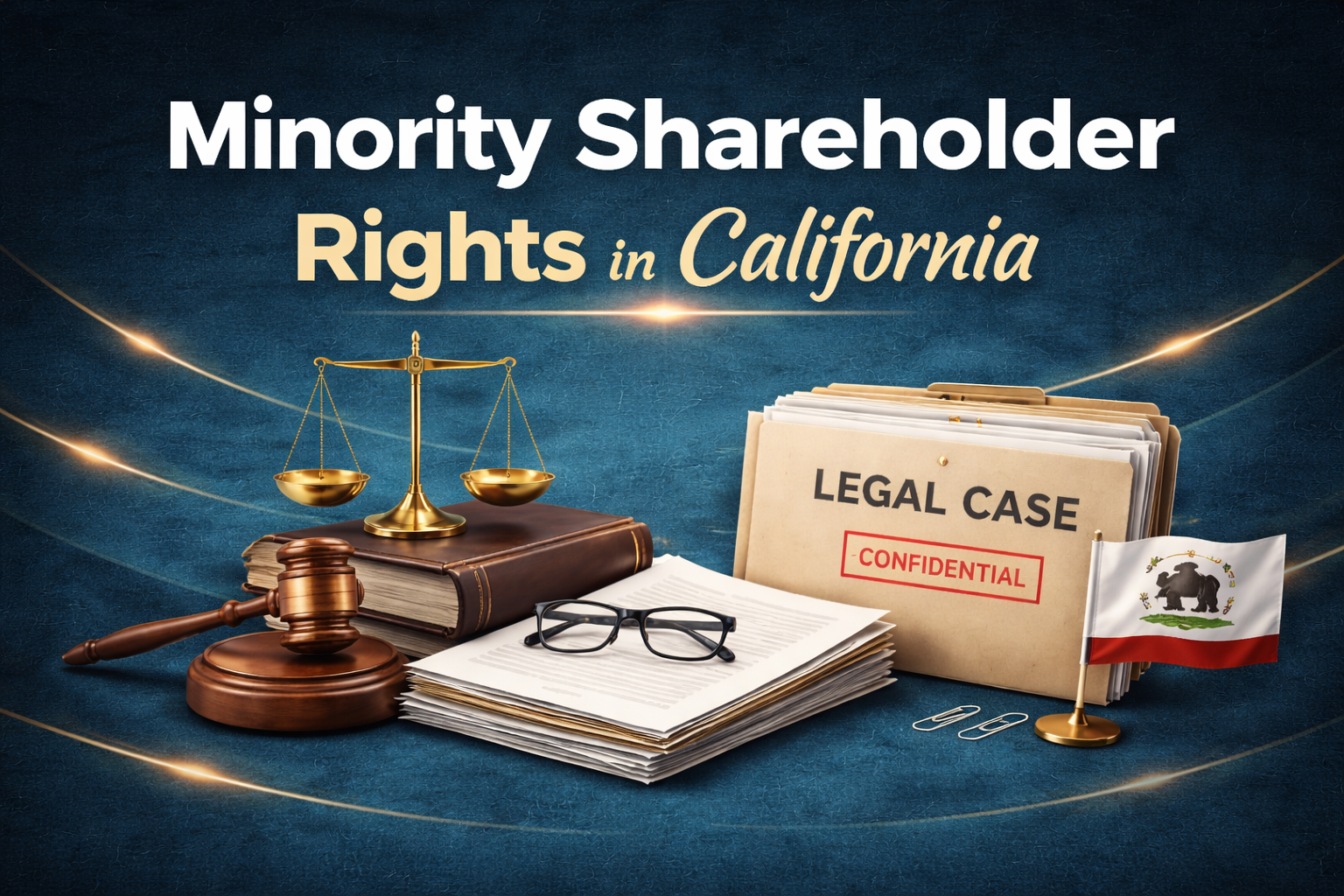
Minority shareholders in California have significant legal protections against unfair treatment by majority owners — including fiduciary duty claims, inspection rights, oppression remedies, dissolution and buyout options, and derivative lawsuits. The key is acting before the dispute escalates and evidence disappears.
Fiduciary Duties Majority Shareholders Owe to Minorities
In a closely held California corporation, majority shareholders owe fiduciary duties to minority shareholders. The California Supreme Court established this principle in Jones v. H.F. Ahmanson & Co. (1969) 1 Cal.3d 93, holding that majority shareholders must exercise their control with inherent fairness toward the minority — they cannot use their controlling position to benefit themselves at the minority's expense.
This duty prohibits structuring transactions to funnel value away from the minority — through excessive compensation to majority-owner employees, below-market asset sales to related parties, or decisions that dilute the minority's stake without business justification.
Inspection Rights: What Minority Shareholders Can Demand
California Corporations Code section 1600 gives shareholders the right to inspect the corporation's accounting books, records, and minutes upon written demand stating the purpose. A shareholder holding at least five percent of outstanding shares may also inspect and copy the record of shareholders. If the corporation refuses, the shareholder may petition the superior court for an order compelling inspection.
Shareholder Oppression: California's Protections
California Corporations Code section 1800 allows a shareholder to petition for involuntary dissolution when those in control have engaged in conduct that is "illegal, oppressive, or fraudulent." Oppressive conduct includes eliminating the minority's role in management without justification, withholding dividends while compensating majority-owner employees excessively, and structuring decisions to squeeze out the minority at an artificially low valuation.
Example: Two founders hold 70% and 30% of a Saratoga software company. After a disagreement, the 70% owner terminates the 30% owner's employment, stops paying dividends, and begins drawing a salary triple what comparable executives receive. The 30% owner has no exit and no income. This pattern is the paradigmatic fact pattern for a shareholder oppression claim in California.
Dissolution and Buyout Options
When a minority shareholder petitions for dissolution under Corporations Code section 1800, California law allows the majority to avoid dissolution by electing to purchase the minority's shares at fair value. The court supervises this process and may appoint an appraiser if the parties cannot agree on valuation. California courts have awarded minority shareholders the full pro-rata value without applying a minority discount, particularly where the majority's conduct was oppressive.
Derivative Lawsuits: Suing on Behalf of the Corporation
When the corporation itself has been harmed by the wrongdoing of directors or majority shareholders, a minority shareholder may bring a derivative lawsuit on the corporation's behalf. Under Corporations Code section 800, the shareholder must have been a shareholder at the time of the wrongdoing and must make a demand on the board before filing, unless demand would be futile. Successful derivative claims can recover the value diverted from the corporation and, in appropriate cases, attorney's fees.
Frequently Asked Questions
Under Jones v. H.F. Ahmanson & Co. (1969) 1 Cal.3d 93, majority shareholders in a closely held California corporation owe a duty of inherent fairness to the minority. They cannot use their controlling position to benefit themselves at the minority's expense through excessive compensation, related-party transactions, or decisions designed to squeeze out the minority at an unfair price.
Yes — by petitioning for involuntary dissolution under Corporations Code section 1800, a minority shareholder can trigger a process that often ends in the majority electing to purchase the minority's shares at court-supervised fair value. This is frequently the most effective remedy where the majority has engaged in oppressive conduct.
Oppressive conduct includes eliminating the minority's employment or management role without legitimate justification, withholding dividends while paying excessive compensation to majority-owner employees, and structuring transactions to artificially depress the value of the minority's stake. It is evaluated holistically — a pattern of conduct designed to make the minority's position untenable often qualifies.
Under Corporations Code section 1600, shareholders may inspect accounting books, records, and minutes upon written demand stating a proper purpose. A shareholder holding at least five percent of outstanding shares may also inspect the shareholder list. If the corporation refuses, the shareholder may petition the superior court for an order compelling inspection.
Under Corporations Code section 800, a shareholder who held shares at the time of the alleged wrongdoing may bring a derivative action after making a demand on the board — unless demand would be futile. Successful derivative claims can recover diverted value and, in appropriate cases, attorney's fees.
If you are a minority shareholder in a California closely held corporation and believe you are being treated unfairly, McLellan Law Group, LLP can evaluate your options. We represent clients throughout Saratoga, San Jose, Campbell, Cupertino, and Santa Clara County. Contact us at mclellanlawgroup.lawbrokr.com or call (408) 963-7533.
About the Authors
Claire Melehani, Esq.
Civil litigation attorney at McLellan Law Group with extensive experience representing clients in business disputes throughout Silicon Valley and Santa Clara County.
Steven McLellan, Esq.
Founding attorney at McLellan Law Group, specializing in business litigation and civil procedure throughout Silicon Valley and Santa Clara County.
Advertising Material Disclaimer: This article is an advertisement for legal services by McLellan Law Group, LLP. The information provided is for general informational purposes only and does not constitute legal advice. Reading this article does not create an attorney-client relationship. Prior results do not guarantee a similar outcome. Responsible Attorney: Claire Melehani, Esq., 20665 4th Street, Suite 202, Saratoga, CA 95070.