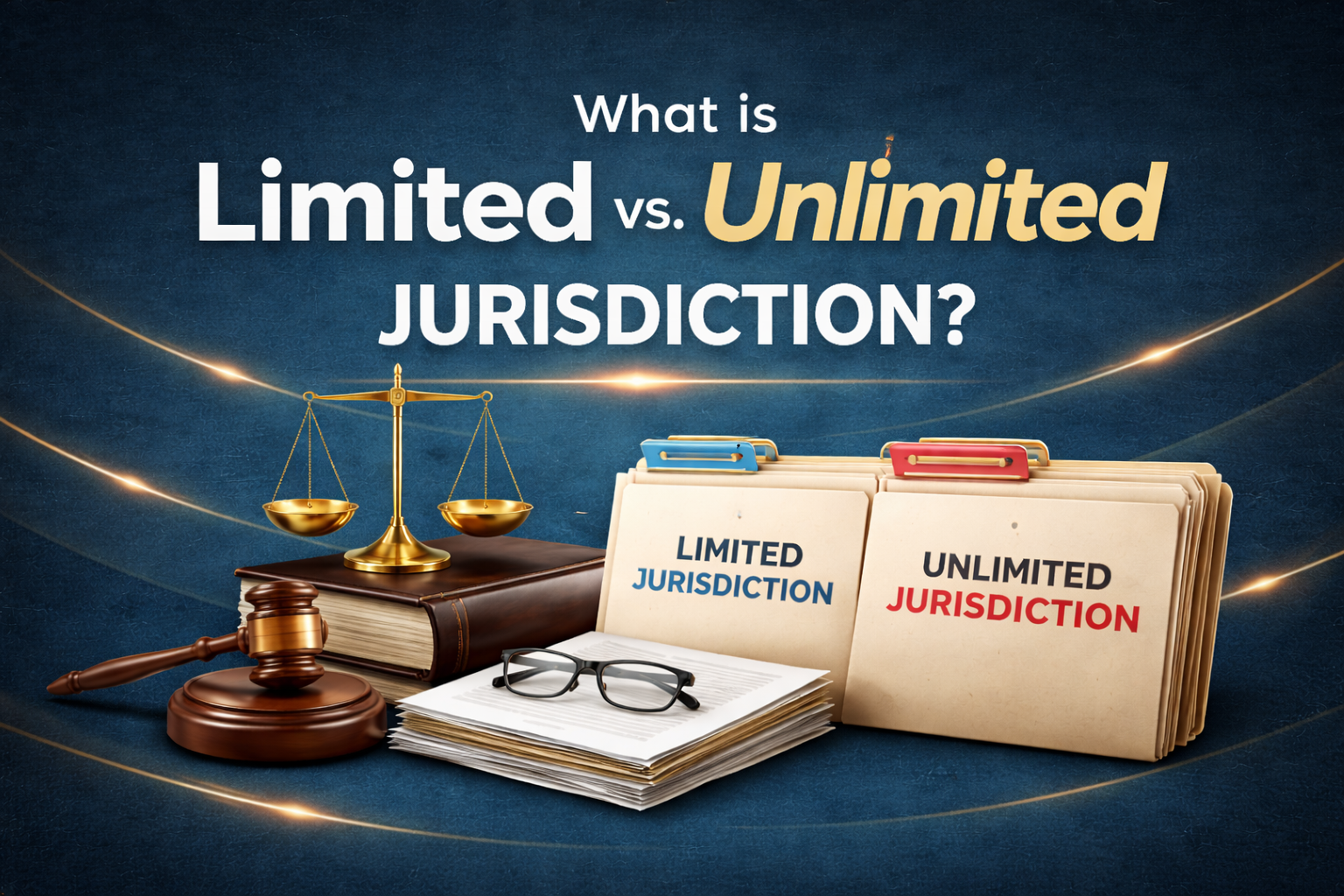
What Is Limited Versus Unlimited Civil Jurisdiction in California?
Claire Melehani, Esq. & Steven McLellan, Esq.·
September 2026 ·
8 min read
Before you file a civil lawsuit in California, one of the most consequential decisions you will make is which court to file in — and whether your case falls under limited or unlimited civil jurisdiction. Getting this wrong can cap your recovery, change your discovery rights, and affect the entire pace of the litigation. Understanding limited versus unlimited jurisdiction California is a threshold step that every litigant should take before filing day.
Why Jurisdiction Classification Matters Before You File
Before filing a civil lawsuit in California, one of the first decisions a litigant must make is which court classification applies to the case. California superior courts hear civil matters under two distinct jurisdictional classifications: limited civil jurisdiction and unlimited civil jurisdiction. The classification determines the procedural rules that govern the case, the discovery tools available to the parties, and the maximum recovery a plaintiff may obtain. Filing in the wrong classification can result in limitations on recovery, procedural complications, and unnecessary cost.
Concrete example:
A Saratoga contractor completes $38,000 in kitchen renovation work and is not paid. He files in limited civil court to save on filing fees, not realizing that the $35,000 cap means he can recover at most $35,000 in that venue — even though his actual damages are higher. Had he filed in unlimited civil court from the outset, he could have pursued his full claim. The jurisdictional error costs him $3,000 he can never recover in that proceeding. The decision is driven primarily by the amount in controversy, but other factors — including the type of claim and the relief sought — also influence the analysis.
"The court you choose shapes the case you can bring. Filing in the wrong classification at the outset can limit your recovery before the litigation even begins."
Limited Civil Jurisdiction: Cases Under $35,000
A limited civil case in California is one in which the amount in controversy does not exceed thirty-five thousand dollars. This threshold was increased from twenty-five thousand dollars effective January 1, 2024, reflecting the Legislature's recognition that many legitimate civil disputes involve amounts that were previously classified as unlimited but are better suited to streamlined procedures.
Limited civil cases are governed by a simplified set of procedural rules designed to reduce cost and delay. Discovery is more restricted than in unlimited civil cases: written discovery is generally limited to thirty-five questions per category, depositions are limited to one per party without leave of court, and the total discovery cutoff is closer to trial than in unlimited matters. These limitations reduce litigation cost but also constrain the ability of parties to develop complex factual records.
The small claims division of the superior court handles cases below twelve thousand five hundred dollars for individuals and five thousand dollars for businesses, with even more abbreviated procedures and no right to attorney representation at the hearing itself.
Unlimited Civil Jurisdiction: Cases Over $35,000
An unlimited civil case is one in which the amount in controversy exceeds thirty-five thousand dollars, or in which the plaintiff seeks relief that cannot be quantified in monetary terms — such as injunctive relief, declaratory judgment, or specific performance of a contract. Most significant business litigation and employment matters in Silicon Valley and Santa Clara County are filed as unlimited civil cases.
Unlimited civil cases are governed by the full California Code of Civil Procedure and the California Rules of Court. Discovery is substantially broader: parties may propound unlimited written discovery subject to judicial oversight, conduct multiple depositions, retain expert witnesses, and engage in the full range of pre-trial motion practice. The Santa Clara County Superior Court's civil complex litigation program handles the most complex unlimited civil matters, including large commercial disputes, class actions, and multi-party litigation.
Reclassification: When the Amount in Controversy Changes
California law permits reclassification of a case when the amount in controversy changes after filing. If a plaintiff files a limited civil case and subsequently discovers that the damages exceed thirty-five thousand dollars — through discovery, expert analysis, or a change in circumstances — the plaintiff may move to reclassify the case as unlimited. Similarly, if a defendant can demonstrate that the plaintiff's actual damages are below the threshold, reclassification to limited jurisdiction may be sought.
Reclassification motions are governed by California Code of Civil Procedure section 403.040 and require a showing that the amount in controversy actually exceeds or falls below the relevant threshold. Courts evaluate the motion based on the face of the pleadings and any supporting evidence submitted by the parties.
Practical Implications for Business and Employment Disputes in the Bay Area
For business disputes in Silicon Valley, the classification decision is rarely difficult: most contract disputes, trade secret matters, and shareholder disputes involve amounts well above the thirty-five-thousand-dollar threshold and are filed as unlimited civil cases from the outset. The same is true for most employment discrimination, wrongful termination, and retaliation claims, where lost wages, emotional distress damages, and potential punitive damages collectively exceed the threshold by a substantial margin.
Where the classification decision is more nuanced is in disputes involving smaller amounts — a commercial landlord-tenant dispute, a contractor payment dispute, or a minor employment matter where the recoverable damages are genuinely uncertain. In those cases, counsel must weigh the procedural advantages of unlimited jurisdiction against the cost of broader discovery and the risk of a recovery that does not justify the investment. McLellan Law Group represents clients in Saratoga, San Jose, Cupertino, Los Gatos, and throughout Silicon Valley and Santa Clara County.
Frequently Asked Questions
Limited civil jurisdiction applies to cases where the amount in controversy does not exceed $35,000; unlimited civil jurisdiction applies to cases above that threshold or where non-monetary relief is sought. The classification determines the procedural rules, the scope of available discovery, and whether the full range of pre-trial motion practice is available.
Effective January 1, 2024, the threshold was raised from $25,000 to $35,000. Cases where the amount in controversy exceeds $35,000, or where the plaintiff seeks injunctive or declaratory relief, must be filed as unlimited civil cases.
Yes — a party may move for reclassification under California Code of Civil Procedure section 403.040 when the amount in controversy changes or the initial classification was incorrect. The moving party must show that the actual amount exceeds or falls below the applicable threshold.
Yes — a plaintiff who files in limited civil jurisdiction generally cannot recover more than $35,000 in that proceeding regardless of actual damages. If true damages exceed the threshold, filing in limited jurisdiction results in an under-recovery that cannot be corrected after judgment.
Unlimited civil cases in Santa Clara County are filed with the Santa Clara County Superior Court in San Jose. Complex matters involving large commercial disputes, class actions, or multi-party litigation may be assigned to the court's civil complex litigation program.
ADVERTISING MATERIAL DISCLAIMER — This communication is an advertisement for legal services by McLellan Law Group, LLP. The content is intended for informational purposes only and should not be construed as legal advice. Each case and its facts are unique, and the outcomes mentioned in this advertisement, if any, are not guarantees of future results. Responsible Lawyer: Claire Melehani, Esq., 20665 4th Street, Suite 202, Saratoga, CA 95070.
California's 2026 law requires disclosure of AI-altered listing photos. Real estate attorney Saratoga CA explains your rights. Serving Silicon Valley. Free consult.
Trust & probate attorney Saratoga CA explains legal grounds for contesting a trust in California. Serving Silicon Valley & Santa Clara County. Free consultation.
Business litigation attorney Saratoga CA explains what a demurrer is in California civil procedure. Serving Silicon Valley & Santa Clara County. Free consult.
Real estate attorney Saratoga CA explains easements and encroachments in California property disputes. Serving Silicon Valley & Santa Clara County. Free consult.
Labor attorney Saratoga CA explains overtime rights for salaried employees. McLellan Law Group serves Silicon Valley & Santa Clara County. Free consultation.
Trust & probate attorney Saratoga CA explains guardianship and conservatorship red flags in California. Serving Silicon Valley & Santa Clara County. Free consult.
Business litigation attorney Saratoga CA explains default judgments in California civil procedure. Serving Silicon Valley & Santa Clara County. Free consult.
Serving California companies, individuals, and trusts in civil litigation, alternative dispute resolution, and asset protection.
Advertising Material Disclaimer - This website is an advertisement for legal services by McLellan Law Group, LLP. Information provided is for general purposes only and not legal advice. Results vary by case. Responsible Attorney: Claire Melehani, Esq., 20665 4th Street, Suite 202, Saratoga, CA 95070