When a Contract Isn't Worth the Paper It's On: Key Mistakes That Void Agreements in California
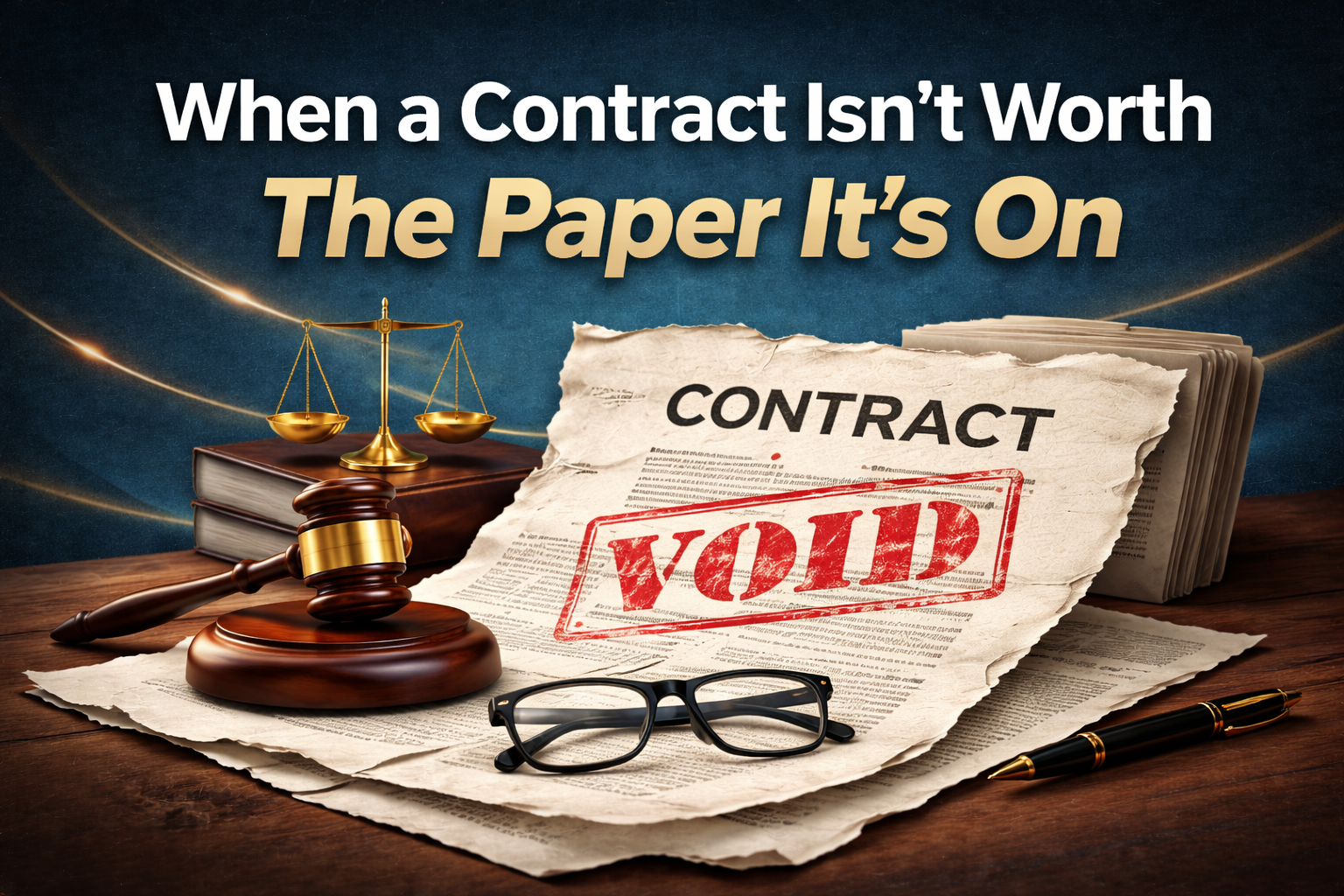
A signed contract is not automatically an enforceable contract. California law imposes specific formation requirements, and a document that fails to meet them — due to lack of mutual assent, missing consideration, fraud, illegal subject matter, incapacity, or failure to satisfy the statute of frauds — may be void or voidable regardless of the signatures it bears.
Mistake One: Lack of Mutual Assent
A valid California contract requires a meeting of the minds — a mutual agreement by both parties to the same terms. Courts apply an objective standard: would a reasonable person in the position of each party have understood the agreement in the same way? Where the answer is no, the contract may be void for lack of mutual assent, or voidable on grounds of mistake.
Mistake Two: Absence of Consideration
Every enforceable California contract must be supported by consideration — something of value exchanged by each party. A contract supported by only one party's promise, with nothing given in exchange, is generally unenforceable as a gratuitous promise. An employer who presents a non-disclosure or arbitration agreement to a current employee after hire, without offering additional compensation or benefit, may have failed to provide adequate consideration.
Mistake Three: Illegal Subject Matter
A contract whose subject matter is illegal under California or federal law is void and cannot be enforced by either party. Non-compete agreements in California are void on this basis: Business and Professions Code section 16600 renders them unenforceable as a matter of statutory prohibition. Contracts that violate California's consumer protection laws, labor regulations, or licensing requirements may similarly be void.
Mistake Four: Fraud, Misrepresentation, or Duress
A contract induced by fraud, material misrepresentation, or duress is voidable at the election of the aggrieved party. Fraud requires proof that a party made a false representation of a material fact, knowing it to be false, with the intent to induce the other party to enter the agreement, and that the other party justifiably relied on that representation to their detriment. Economic duress renders a contract voidable when one party had no reasonable alternative but to agree due to wrongful conduct.
Mistake Five: Lack of Capacity
California law requires that each party to a contract have the legal capacity to enter into it. Minors — individuals under the age of eighteen — may disaffirm most contracts. Adults who lacked mental capacity at the time of contracting, due to cognitive impairment, intoxication, or mental illness, may also seek to void the agreement.
Mistake Six: Failure to Satisfy the Statute of Frauds
Certain categories of contracts are unenforceable unless they are in writing and signed by the party to be charged. California's statute of frauds (Civil Code section 1624) requires written agreements for contracts that cannot be performed within one year, contracts for the sale of real property, and contracts for the sale of goods valued at $500 or more. An oral agreement that falls within the statute of frauds is generally unenforceable regardless of the clarity of the parties' understanding.
Frequently Asked Questions
A contract is void in California when it lacks one or more essential formation elements — mutual assent, consideration, legal subject matter, or capacity — or when it violates a statute or public policy. A void contract has no legal effect and cannot be enforced by either party.
Yes, in most circumstances. However, contracts for real property, contracts that cannot be performed within one year, and contracts for goods over $500 must satisfy the statute of frauds. For any significant business agreement, a written contract reviewed by an attorney is strongly advisable.
A contract signed under duress is voidable — you may have the right to rescind it and restore the parties to their pre-contract positions. Economic duress is recognized under California law where one party exploited a position of financial advantage to extract unreasonable terms. Consult a civil litigation attorney promptly, as delay may affect your position.
Consideration is the exchange of value that makes a contract binding — it can be a promise to perform, performance of an act, or forbearance from a legal right. Both parties must provide consideration. A one-sided promise with no reciprocal obligation is generally an unenforceable gratuitous promise.
A business litigation attorney can evaluate whether a valid and enforceable contract was formed, identify defenses that may void or limit the agreement, assess the strength of a breach claim, and advise on the most efficient path to resolution — whether through negotiation, mediation, or litigation.
If you are involved in a contract dispute or have questions about the enforceability of an agreement, McLellan Law Group, LLP offers a complimentary initial consultation. We serve clients throughout Saratoga, San Jose, Campbell, Cupertino, and Santa Clara County. Contact us at mclellanlawgroup.lawbrokr.com or call (408) 963-7533.
About the Authors
Claire Melehani, Esq.
Business litigation attorney at McLellan Law Group with extensive experience representing clients in contract disputes before the Santa Clara County Superior Court.
Steven McLellan, Esq.
Founding attorney at McLellan Law Group, specializing in business litigation and contract disputes throughout Silicon Valley and Santa Clara County.
Advertising Material Disclaimer: This article is an advertisement for legal services by McLellan Law Group, LLP. The information provided is for general informational purposes only and does not constitute legal advice. Reading this article does not create an attorney-client relationship. Prior results do not guarantee a similar outcome. Responsible Attorney: Claire Melehani, Esq., 20665 4th Street, Suite 202, Saratoga, CA 95070.