Meta AI Layoffs 2026: What California Employees Need to Know About Their Rights
Meta filed WARN Act notices covering 3,196 Bay Area employees across five locations, all effective July 22, 2026 — part of an 8,000-person global AI restructuring. If you were laid off and did not receive 60 days' written notice, you may be entitled to up to 60 days of back pay under California's WARN Act, separate from any severance Meta offered. Individual selections may also raise age discrimination, retaliation, or other employment claims.
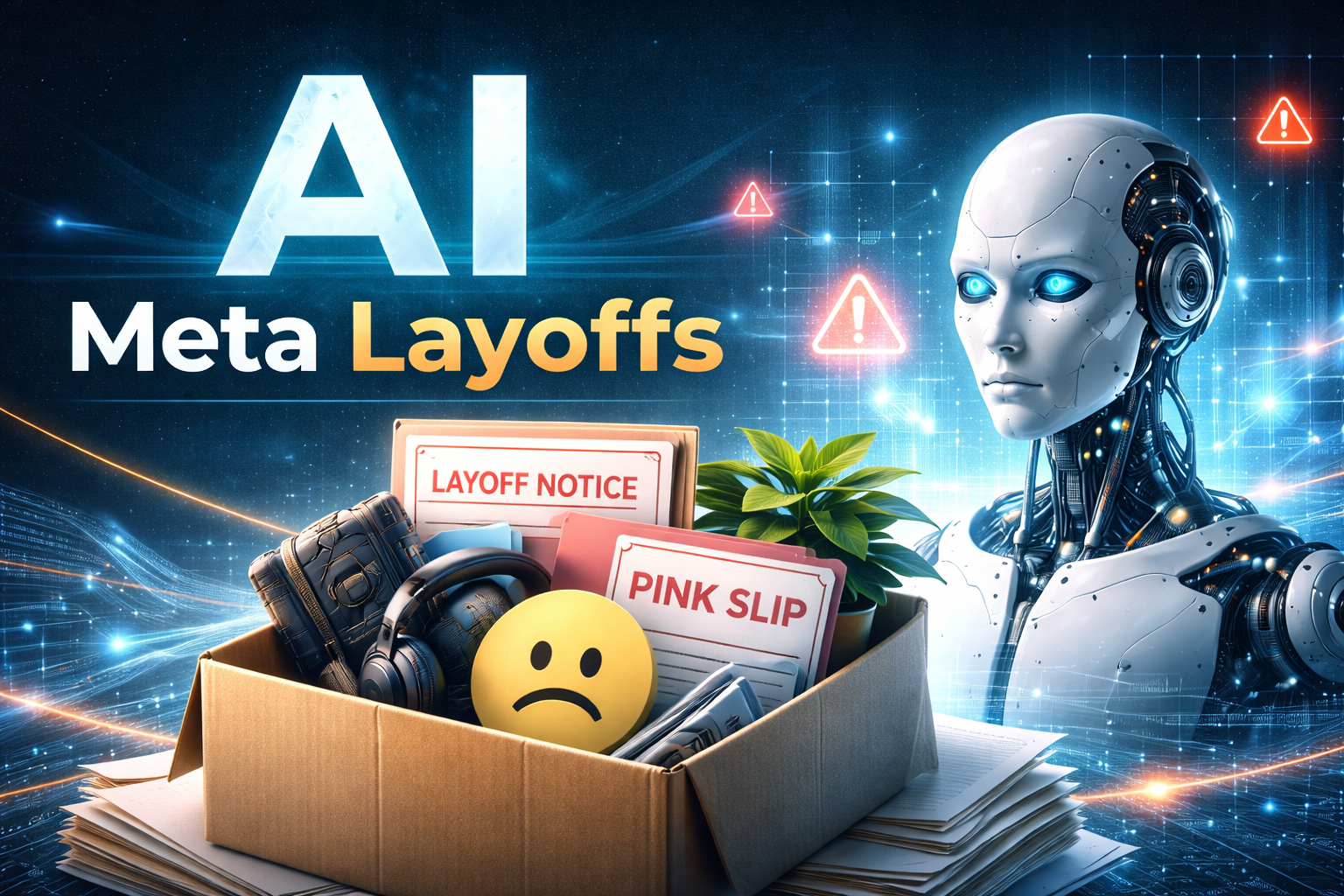
Meta's shift toward AI-driven operations has reshaped its California workforce across multiple rounds in 2026. The company cut approximately 8,000 positions globally as part of an AI restructuring that CEO Mark Zuckerberg described as a turning point for how the company works. California employees bore a significant share of those cuts — and a significant share of them may have legal claims that go beyond what Meta's severance package reflects.
What Happened: Meta's 2026 California Layoffs by the Numbers
Meta's 2026 California layoffs occurred in three documented waves. In January 2026, the company filed WARN notices covering 272 employees at its Burlingame and Playa Vista locations as part of approximately 1,500 cuts to its Reality Labs division. In March through May 2026, Meta reduced approximately 700 roles in recruiting, sales, and operations, with WARN filings covering 124 Burlingame employees and 74 in Sunnyvale. The largest wave came in July 2026: WARN filings covering 3,196 Bay Area employees — 2,212 at 1 Hacker Way in Menlo Park, 313 in Sunnyvale, and the remainder across Fremont, Burlingame, and San Francisco — all effective July 22, 2026, classified as permanent.
The July WARN filings represent roughly 40 percent of Meta's total 8,000-person global AI restructuring headcount, making them one of the largest single-disclosure layoff events in Silicon Valley history. Legal experts noted that Meta filed WARN notices for far fewer than its total number of affected employees, raising questions about whether the company's WARN Act compliance was complete for all affected workers.
Meta's restructuring costs and capital expenditure projections — $115 to $135 billion for 2026, primarily directed toward AI infrastructure — make clear that the headcount reductions are a deliberate strategic pivot, not a financial emergency. That context matters legally: a planned, deliberate restructuring is one where the employer had time to comply with WARN Act notice requirements and to ensure that individual selection decisions were not driven by unlawful factors.
Your California WARN Act Rights
What Meta Was Required to Do — and What It May Have Missed
California's WARN Act requires employers with 75 or more employees to give 60 days' written advance notice before a mass layoff of 50 or more employees at a single location. Meta's July 2026 Bay Area WARN filings appear to have covered thousands of employees with an effective date of July 22, 2026. Whether those notices were filed timely — 60 days before the effective date — and whether they complied with the 2026 SB 617 content requirements are separate questions each affected employee should verify.
The more significant issue is what happened to employees who were not covered by any WARN filing. Reporting on the 8,000-person global restructuring noted that Meta filed WARN notices for only a fraction of affected California employees in earlier rounds. Employees who were terminated without receiving 60 days' written notice may be entitled to up to 60 days of back pay and lost benefits under Labor Code section 1402 — per employee, separate from and cumulative with any severance offered.
- Effective January 1, 2026, SB 617 added four mandatory content requirements to every Cal-WARN notice — including workforce development board contact information, rapid-response services language, and CalFresh information. A timely notice that omits any of these elements is a content-deficient notice
- If you received a WARN notice, review it against the SB 617 requirements before assuming it was fully compliant
- If you did not receive any written WARN notice before your termination, you may have a Cal-WARN back pay claim regardless of any severance Meta offered
- California's WARN Act provides one-way attorney's fee shifting — a prevailing employee recovers fees from the employer
Was Your Selection Lawful? What California Law Examines
Meta's restructuring was real. The company's AI pivot is documented and its financial rationale is public. None of that means every individual selection within the reduction was lawful. California courts regularly see wrongful termination claims arising from mass reductions where the employer used the restructuring framework to eliminate employees for unlawful reasons.
Your selection may warrant closer scrutiny if any of the following apply:
- Age (40 or older): FEHA prohibits age-based selection. Meta's cuts targeted engineering, recruiting, sales, and operations roles — workforce segments with significant representation of experienced workers over 40. If you were selected while younger employees in comparable roles were retained, that disparity is worth evaluating
- Disability or medical condition: If you were on medical leave, had recently requested an accommodation, or have a documented condition, your selection timing may raise CFRA or FMLA interference issues
- Prior protected complaint: An HR complaint, a wage or safety report, a discrimination allegation, or any other protected activity before your selection date is a fact pattern an employment attorney should evaluate
- Pregnancy or parental leave: Selection announced or effective during pregnancy, parental leave, or shortly after returning from it is legally significant
- National origin or race: Disparate impact on a protected group can support a discrimination claim even without proof of intent
The WARN Act filing is public. Meta's July 2026 WARN filings name specific locations and employee counts. If you were terminated from a location not covered by a filed notice, or if your effective date does not match the notice period, those discrepancies are worth discussing with an attorney before you sign a release.
What to Do Before You Sign Meta's Severance Agreement
If you are 40 or older and the layoff was part of a group reduction — which this clearly is — OWBPA requires at least 45 days to review the agreement, not the shorter periods some employers prefer. You also have 7 days to revoke after signing. A release that did not include required OWBPA disclosures, or that was presented with an inadequate review period, may be defective as to your federal age discrimination rights.
Check whether you received a written WARN notice before your termination date, when it was delivered, and whether it includes all four SB 617-required disclosures: the workforce board coordination statement, the board's contact information, standardized rapid-response services language, and CalFresh information. If no notice was provided, or if the notice was late or content-deficient, your WARN Act back pay claim may be worth significantly more than Meta's offered severance.
Write down everything you know about your role, your team's composition before and after the layoff, your performance history, and any protected activity you engaged in before the announcement. Request your personnel file under Labor Code section 1198.5 and your wage statements under Labor Code section 226. Preserve all company communications before your system access is revoked, and consult an employment attorney before transferring any documents that may contain proprietary or confidential information.
Meta's severance agreement was designed by Meta's legal team. It includes a broad release of all claims — including WARN Act back pay claims, FEHA discrimination claims, CFRA medical leave claims, and any other employment claim you may have. An employment attorney will evaluate the severance against your specific facts, identify every applicable legal theory, and advise on whether the offer reflects what California law actually entitles you to.
Frequently Asked Questions
Yes. Meta filed California WARN Act notices covering 3,196 Bay Area employees across five locations: 2,212 at 1 Hacker Way in Menlo Park, 313 in Sunnyvale, and the remainder across Fremont, Burlingame, and San Francisco, all effective July 22, 2026. Earlier 2026 notices covered the January Reality Labs cuts in Burlingame and Playa Vista, and the spring rounds in Burlingame and Sunnyvale. Reporting noted that Meta filed notices covering far fewer employees than its total reduction, raising compliance questions for workers not named in any filing.
Possibly. California's WARN Act requires employers with 75 or more employees to give 60 days' written advance notice before a mass layoff of 50 or more employees at a single location. If Meta failed to give timely and content-compliant notice, affected employees may be entitled to up to 60 days of back pay and benefits under Labor Code section 1402, separate from any severance Meta offered. Consult an employment attorney before signing any release — signing waives this claim.
Yes. A mass layoff does not insulate an employer from wrongful termination liability. If your selection was influenced by a protected characteristic — age, disability, pregnancy, national origin, race, gender — or by prior protected activity such as an HR complaint or medical leave request, you may have claims under California's FEHA independent of the general restructuring. California's FEHA applies to employers with five or more employees and provides broader protections than federal law.
Legal experts cited in reporting on the layoffs noted that employees who did not receive 60 days' written notice under Cal-WARN may be entitled to up to 60 days of back pay and benefits under Labor Code section 1402. The absence of a WARN filing does not eliminate the employer's obligation — it may create liability. California's WARN Act is stricter than the federal WARN Act and applies to employers with 75 or more employees, a lower threshold than the federal 100-employee minimum.
California courts have applied a three-year statute of limitations to Cal-WARN back pay claims. For FEHA discrimination and retaliation claims, you must file with the California Civil Rights Department within three years of the adverse action. For Tameny public policy wrongful termination claims, the period is generally two years. Multiple deadlines may run simultaneously from the date of your layoff. Consult an attorney before the earliest deadline passes — and before you sign any release.
The Bottom Line for Laid-Off Meta Employees in California
Meta's AI restructuring is real, its strategic rationale is documented, and the company has the financial resources to execute it at scale. None of that determines whether your individual layoff was lawful or whether the severance Meta is offering reflects what California law entitles you to.
The WARN Act compliance questions raised by the gap between Meta's reported 8,000-person global reduction and its California WARN filings are real legal questions — not speculative ones. So is the question of whether any individual selection within the reduction was influenced by age, disability, pregnancy, prior complaints, or any other unlawful factor.
At McLellan Law Group, LLP, our employment attorneys represent California employees in WARN Act claims, severance negotiations, and wrongful termination cases throughout Saratoga, San Jose, Menlo Park, Sunnyvale, Burlingame, Fremont, San Francisco, and the greater Bay Area. Request a complimentary initial consultation at mclellanlawgroup.lawbrokr.com or call (408) 963-7533.
About the Authors
Claire Melehani, Esq.
Employment law attorney at McLellan Law Group with extensive experience representing employees in wrongful termination, discrimination, and retaliation matters throughout Silicon Valley.
Steven McLellan, Esq.
Founding attorney at McLellan Law Group, specializing in employment law and business litigation throughout Silicon Valley and Santa Clara County.
Advertising Material Disclaimer: This article is an advertisement for legal services by McLellan Law Group, LLP. The information provided is for general informational purposes only and does not constitute legal advice. Reading this article does not create an attorney-client relationship. Prior results do not guarantee a similar outcome. Responsible Attorney: Claire Melehani, Esq., 20665 4th Street, Suite 202, Saratoga, CA 95070.