How to Document What’s Happening at Work: The Legal Way to Protect Yourself in California
Published August 2026 | California Employment Law
The right way to document problems at work in California is a factual written log, kept on a personal device, made close in time to each event. The wrong ways, secretly recording conversations and downloading company documents, can turn your own evidence into your own legal problem. Layoffs, restructuring, tense conversations with a manager: a lot of California employees are living through moments right now that they sense they should be writing down. Most people are right to feel that instinct. Most people also don’t know there’s a wrong way to act on it. This guide covers how to document what’s happening at work safely, legally, and in a way that actually holds up later.
Why Writing It Down Matters More Than You Think
Memory fades faster than people expect, especially under stress. Six months from now, you won’t remember the exact words your manager used, or the exact date the schedule changed, or who else was in the room. Your employer, meanwhile, often does have a record: performance notes, HR emails, and internal messages. If a dispute ever comes up, the side with a clear, contemporaneous account is in a stronger position than the side relying on memory. That’s true whether you ever need a lawyer or not.
What to Write Down, and How
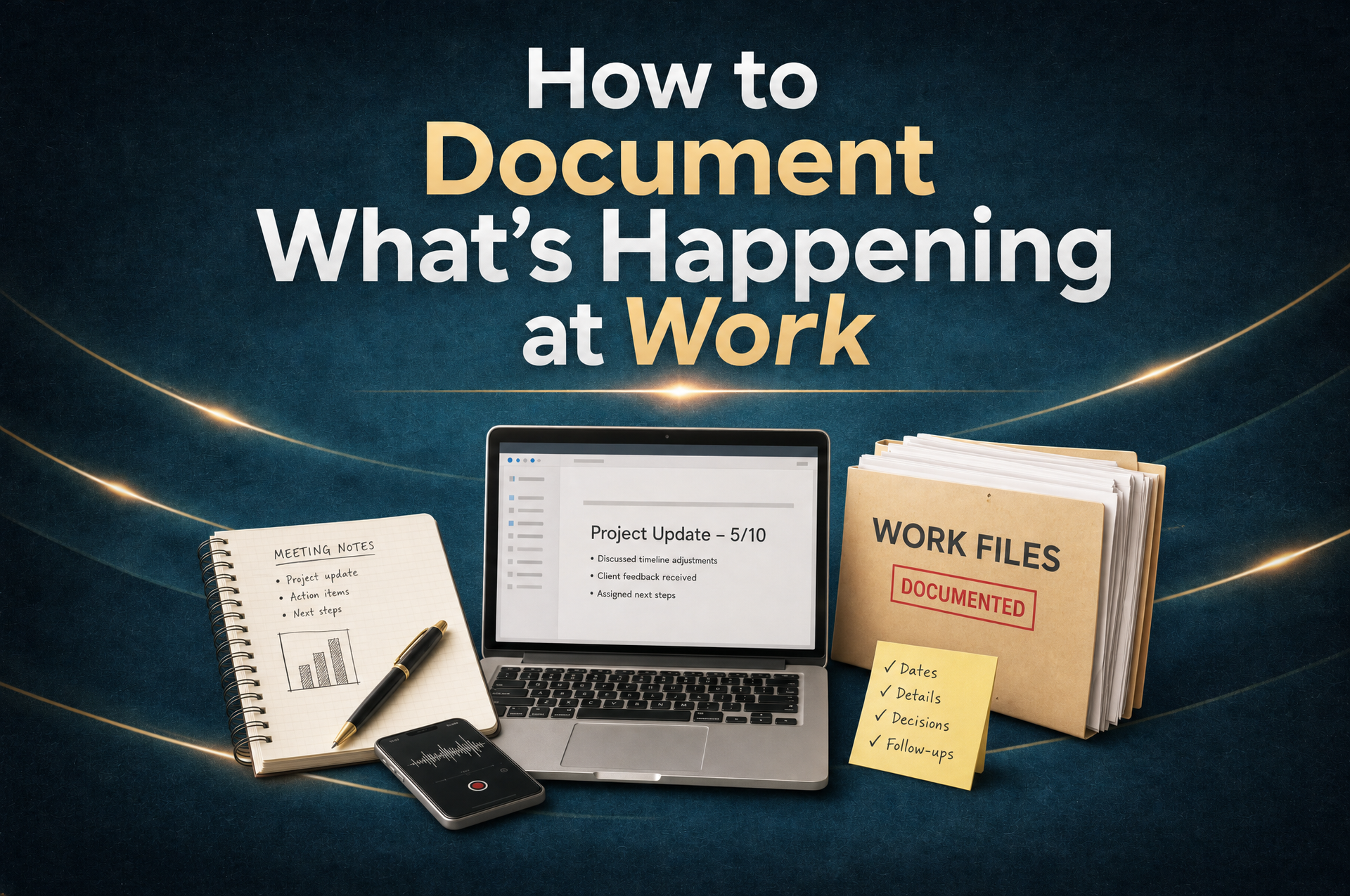
The most useful record is boring on purpose. For each incident, capture:
- Date and time, as close to the moment as possible
- Location and who was present, including anyone who witnessed it
- What was said or done, as close to word-for-word as you can manage
- What happened immediately after: your response, their response, any follow-up
- How it affected your work: a missed deadline, a schedule change, a project reassignment
Keep the tone factual, not emotional. Not because your feelings aren’t valid (they are) but because a log that reads like a police report holds up better than one that reads like a diary. Save the emotional processing for a conversation with someone you trust; save the log for the facts.
Where to Keep It (and Where Not To)
Store your notes somewhere you control: a personal email account or a personal device, not your work laptop or a company drive. The moment your employment ends, access to company systems can disappear immediately, sometimes without warning. If your only record lives in your work email, it may not be your record anymore.
Do not download company documents
This is about your own observations and notes, not company documents. Downloading confidential business records to a personal account can create a separate legal problem for you, even if your intentions are good. It can violate confidentiality agreements and company policies, and it can hand your employer a claim against you in the middle of your own dispute. If a document matters, write your own summary of what it says and when you saw it, rather than taking the document itself.
The Recording Question: Why Secret Recordings Are Illegal in California
This is the part almost nobody tells you, and it matters. California is one of the strictest states in the country when it comes to recording conversations. Under Penal Code 632, recording a confidential conversation, whether in person, by phone, or on video, generally requires the consent of everyone involved, not just you.
Secretly recording a conversation can hurt you more than it helps
Recording someone without their knowledge can expose you to criminal charges and civil liability. And in most cases, a recording made without proper consent can’t even be used later as evidence. The recording that felt like protection becomes a liability, and the evidence it captured is lost anyway.
We understand the instinct. If a conversation feels important, recording it can feel like the obvious way to protect yourself. In California, it’s usually the riskier choice, not the safer one. A written note, made right after the conversation, is the tool that protects you without creating a new legal problem of your own.
You Also Have the Right to Your Own File
Here’s a tool most employees never use: under California Labor Code 1198.5, current and former employees can request to inspect and receive a copy of their own personnel records, including performance reviews, disciplinary notices, and anything related to a grievance concerning you. Your employer generally has 30 calendar days to respond once you request it in writing. And as of January 1, 2026, that right expanded to include training and education records your employer maintains about you as well.
This isn’t about assuming anything has gone wrong. It’s about knowing your own file exists, and knowing you’re allowed to see what’s in it.
What You Should Do Now
- Start today, not after something bigger happens. The best documentation habit is the one you build before you need it.
- Write facts, not feelings, in the log itself. Save the emotional context for people you trust.
- Keep your notes somewhere only you control. Personal email or a personal device, never a work system.
- Don’t record conversations without everyone’s consent. In California, that step can hurt you more than it helps.
- Know you can request your own personnel file. You don’t need a reason. You just need to ask in writing.
Frequently Asked Questions
Is it illegal to secretly record my boss or coworkers in California?
Generally, yes. Under California Penal Code 632, recording a confidential conversation, whether in person, by phone, or on video, generally requires the consent of everyone involved, not just you. Recording someone without their knowledge can expose you to criminal charges and civil liability, and in most cases a recording made without proper consent cannot even be used later as evidence.
Can I download company emails or documents to keep as evidence?
This is risky and can create a separate legal problem for you, even if your intentions are good. Downloading confidential business records to a personal account can violate confidentiality agreements and company policies. If a document matters, write your own summary of what it says and when you saw it, rather than taking the document itself.
Can I see my own personnel file in California?
Yes. Under California Labor Code 1198.5, current and former employees can request to inspect and receive a copy of their own personnel records, including performance reviews, disciplinary notices, and anything related to a grievance concerning you. Your employer generally has 30 calendar days to respond once you request it in writing. As of January 1, 2026, that right also covers training and education records your employer maintains about you.
Should I keep my workplace notes on my work computer?
No. Store your notes somewhere you control, such as a personal email account or a personal device, never a work laptop or a company drive. The moment your employment ends, access to company systems can disappear immediately, sometimes without warning. If your only record lives in your work email, it may not be your record anymore.
Will my written notes actually hold up later?
A clear, factual, contemporaneous log made close in time to the events is far stronger than memory alone, and it is exactly the kind of record an attorney can work with. Keep it factual rather than emotional: dates, times, locations, who was present, what was said, and how it affected your work.
How McLellan Law Group, LLP Can Help
Most people don’t start documenting because something dramatic happened. They start because a quiet feeling told them something was off, and they wanted to trust their own account of events later. That instinct is worth listening to. It just needs the right method behind it. McLellan Law Group, LLP represents California employees throughout Silicon Valley, Santa Clara County, the Bay Area, and all of California. If you’re not sure whether something you’re experiencing at work is worth documenting, or you want a second set of eyes on what you’ve already written down, we offer one complimentary initial consultation at (650) 383-1266. Not a sales call: a real conversation about what you’re dealing with and what your options are.
Questions about documenting a workplace situation? Contact McLellan Law Group, LLP at mclellanlawgroup.com.
Attorney advertisement by McLellan Law Group, LLP. This is general information only and not legal advice. Prior results do not guarantee a similar outcome. Responsible attorney: Claire Melehani, Esq. 20655 4th Street, Ste. 202, Saratoga, CA 95070.