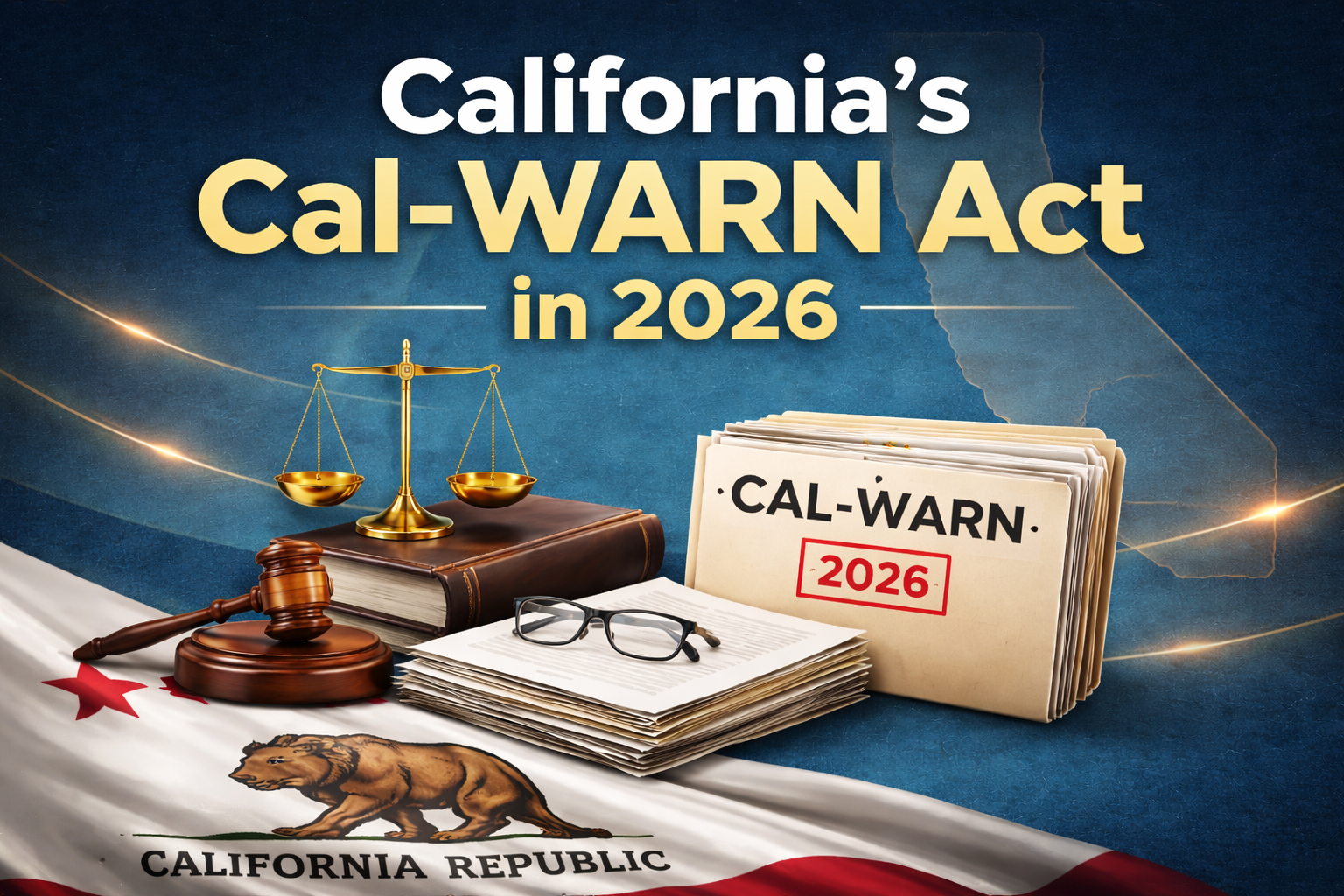
California’s Cal-WARN Act in 2026: What Employers Must Know After SB 617
California employers navigating workforce reductions in 2026 are operating under a WARN Act that changed significantly on January 1st. Senate Bill 617, signed by Governor Newsom in October 2025, expanded what every Cal-WARN notice must contain, and a notice template that was fully compliant in 2025 is likely non-compliant today. For businesses throughout Silicon Valley, Santa Clara County, and the Bay Area, where layoffs in the tech sector have continued at a rapid pace, this is not an abstract compliance issue. It is a live litigation risk.
What Cal-WARN Requires: The Basics
California’s Worker Adjustment and Retraining Notification Act, codified at Labor Code sections 1400 through 1408, requires covered employers to provide 60 days’ advance written notice before a mass layoff, plant closure, or relocation. The statute covers any California employer with 75 or more full- or part-time employees. A mass layoff is defined as the elimination of 50 or more positions at a single location within any 30-day period.
The Four New Disclosure Requirements Under SB 617
SB 617 amended Labor Code section 1401 to add four mandatory disclosure categories to every Cal-WARN notice, effective January 1, 2026:
Service coordination: the notice must state whether the employer will coordinate rapid-response transition services through the local workforce development board, through another entity, or not at all, and regardless of the choice, must list the board’s contact information along with standardized language describing available job-placement and retraining services.
Employer contact information: a functioning email address and phone number so affected employees or state agencies can reach a company representative.
CalFresh information: a brief description of the CalFresh food-assistance program, the CalFresh helpline number, and a link to the program’s official website.
Timeline for coordination: if rapid-response coordination is planned, those services must be arranged within 30 days after the employer issues the 60-day notice.
What SB 617 Did Not Change
It is worth being precise about the scope of the amendment: SB 617 affects only the content of the notice. It did not change which employers are covered, the 60-day advance-notice period, or the statutory definitions of “mass layoff,” “relocation,” or “termination.” Employers who were correctly determining WARN coverage before 2026 do not need to reassess that threshold analysis; they need to update their notice template.
Liability Exposure for Non-Compliance
Employers who fail to comply with Cal-WARN, whether by giving insufficient notice or by giving a notice that omits required disclosures, face liability for back pay and the value of lost benefits for each affected employee for the period of the violation, up to a maximum of 60 days. Civil penalties of up to $500 per day of violation may also apply, along with potential liability for attorney’s fees in a successful enforcement action. Because Cal-WARN claims are generally subject to a three-year statute of limitations, a defective 2026 notice can generate litigation well after the layoff itself has faded from memory.
What Employers Should Do Now
Employers throughout Silicon Valley planning a reduction in force in 2026 should not reuse a pre-2026 WARN notice template without review. Updating the template to include the four new disclosure categories, confirming the correct local workforce development board contact information, and documenting the employer’s rapid-response coordination decision are straightforward steps that meaningfully reduce litigation exposure. McLellan Law Group advises businesses throughout Silicon Valley and Santa Clara County on Cal-WARN compliance and workforce restructuring.
Frequently Asked Questions
California’s WARN Act, codified at Labor Code sections 1400-1408, requires covered employers with 75 or more employees to give 60 days’ advance written notice before a mass layoff, plant closure, or relocation. A mass layoff is the elimination of 50 or more positions at one location within any 30-day period.
Effective January 1, 2026, SB 617 requires every Cal-WARN notice to disclose whether the employer will coordinate rapid-response transition services, list the local workforce development board’s contact information, provide a functioning employer contact email and phone number, and include CalFresh program information. It does not change the 60-day notice period or which employers are covered.
Likely not. A notice template that satisfied Cal-WARN before January 1, 2026 is missing the new disclosure categories SB 617 requires, and using it without updates creates compliance risk for any layoff notice issued after that date.
Non-compliant employers face liability for back pay and the value of lost benefits for each affected employee for the period of the violation, up to 60 days, as well as civil penalties of up to $500 per day and potential liability for attorney’s fees.
Cal-WARN claims are generally subject to a three-year statute of limitations, meaning liability for a defective notice can surface long after the layoff itself has concluded.
McLellan Law Group advises businesses throughout Silicon Valley and Santa Clara County on Cal-WARN compliance and workforce restructuring. If you are planning a reduction in force or reviewing your notice template, we offer a complimentary initial consultation. Contact us at mclellanlawgroup.lawbrokr.com or call (650) 383-1266.
About the Authors
Claire Melehani, Esq.
Partner at McLellan Law Group, based in Saratoga, CA, advising employers and employees on mass layoffs, Cal-WARN compliance, and workforce reductions throughout Silicon Valley.
Steven McLellan, Esq.
Founding attorney at McLellan Law Group, based in Saratoga, CA, specializing in employment law and business litigation throughout Silicon Valley and Santa Clara County.
Advertising Material Disclaimer: This article is an advertisement for legal services by McLellan Law Group, LLP. The information provided is for general informational purposes only and does not constitute legal advice. Reading this article does not create an attorney-client relationship. Prior results do not guarantee a similar outcome. Responsible Attorney: Claire Melehani, Esq., 20665 4th Street, Suite 202, Saratoga, CA 95070.