Fired After Announcing Retirement in California? Here Is What the Law Says
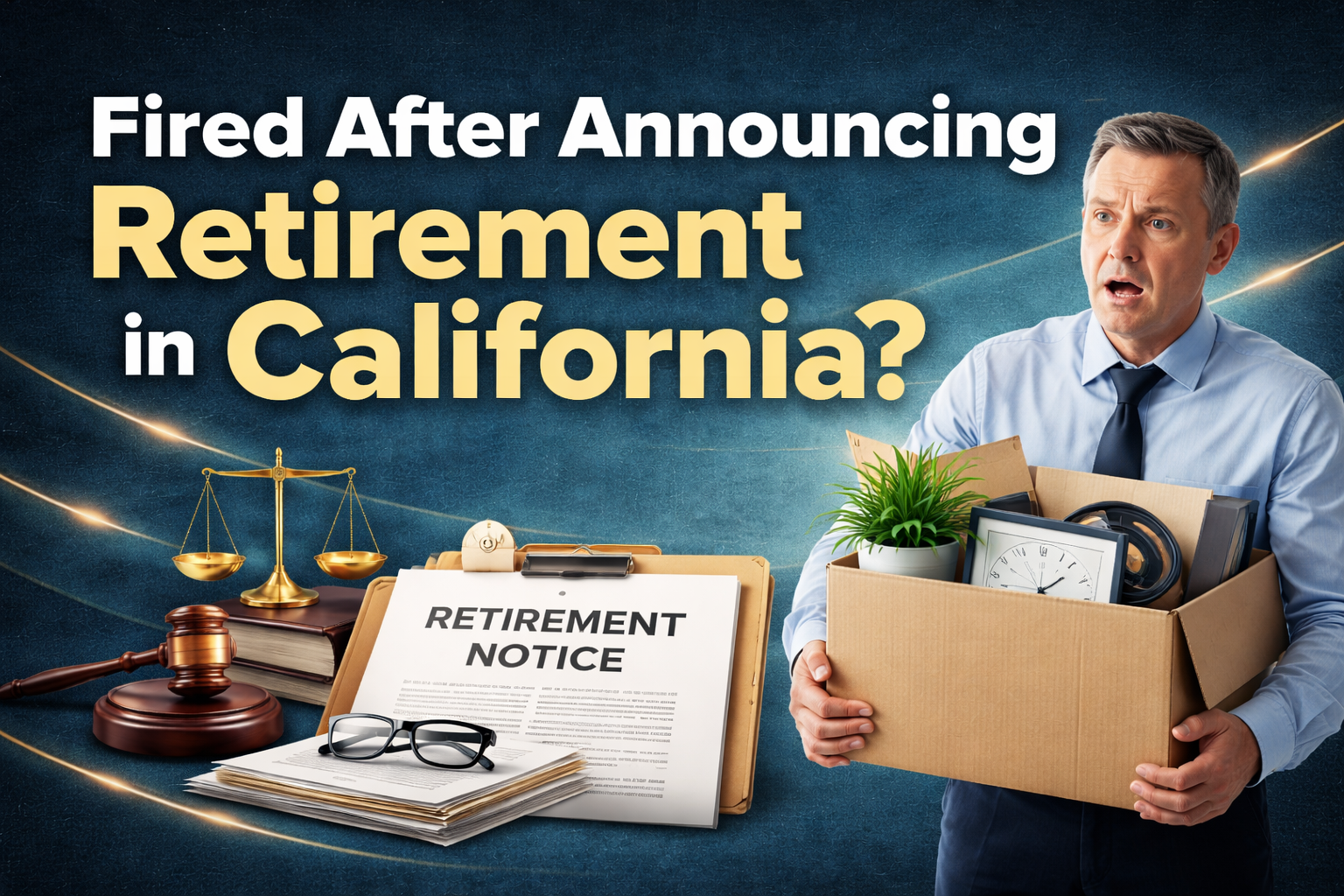
Being fired shortly after you announce retirement is not automatically legal in California. If your employer fired you because of your age, to prevent your pension or retirement benefits from vesting, or in violation of an implied employment contract, you may have significant legal claims — and California law is considerably stronger than federal law on all three fronts.
You worked for decades. You gave your employer advance notice of your retirement date as a professional courtesy. And then, weeks or months before your official last day, your employer shows you the door. Maybe they called it a restructuring. Maybe they cited performance. Maybe they offered you a severance package and asked you to sign it quickly.
This scenario is more common than most people realize — and it is more legally significant than most employers want you to know. California law provides three distinct avenues for challenging a termination that follows a retirement announcement: age discrimination under FEHA, benefit-interference claims under ERISA, and breach of implied or express employment contract. This guide explains each one and tells you what to do.
The Scenario and Why It Matters Legally
Robert is 63 years old and has worked at a Silicon Valley technology company for 14 years. His performance reviews have been consistently strong. In January, he tells his manager he plans to retire in October — eight months from now. Two months later, during a quarterly restructuring announcement, Robert is told his position has been eliminated. He is offered a severance package with a two-week signing deadline. His pension was set to reach its next vesting milestone in June.
His employer says the restructuring is unrelated to his retirement announcement. The severance agreement includes a full release of all claims. Robert is 63 years old and wondering whether he has any options.
Under California law, Robert has several questions worth answering before he signs anything.
California is an at-will state. Under Labor Code section 2922, an employer can generally terminate employment at any time without cause. That baseline rule is real and it applies here — announcing retirement does not, by itself, create a protected status or guarantee continued employment until your stated departure date.
But at-will employment has meaningful exceptions. And for an employee who is 40 or older, close to retirement, approaching a benefit vesting milestone, and terminated shortly after announcing a retirement date, several of those exceptions may apply simultaneously.
Claim 1: Age Discrimination Under California's FEHA
California's Fair Employment and Housing Act (Government Code section 12940 et seq.) prohibits employers from discriminating against employees who are 40 or older on the basis of age. An employer who fires a long-tenured employee shortly after a retirement announcement — when that announcement signals the employee's age and proximity to retirement — may be acting on age-based assumptions, even if the employer does not frame it that way.
29 U.S.C. § 621 et seq.
Applies to employers with 20 or more employees. Requires that age be the "but-for" cause of the adverse action — a higher standard than California's. Emotional distress and punitive damages are not available. EEOC charge must be filed within 300 days in California.
Gov. Code, § 12940
Applies to employers with 5 or more employees. Age need only be a "substantial motivating reason" — a lower and more plaintiff-friendly standard. Emotional distress damages available. Punitive damages available where employer conduct was malicious, oppressive, or fraudulent. One-way attorney's fee shifting. Three-year deadline to file with CRD.
For most California workers, FEHA is the stronger statute. The "substantial motivating reason" standard — confirmed by the California Supreme Court in Harris v. City of Santa Monica (2013) 56 Cal.4th 203 — means your age does not have to be the only or the primary reason you were fired. It needs to have been a substantial factor in the decision.
Evidence of age as a substantial motivating reason in retirement-announcement cases typically comes from:
- The close timing between the retirement announcement and the termination decision
- Comments by managers or HR about retirement plans, "succession planning," or needing "new energy" or "fresh perspective" — language that often codes for age
- Comparative treatment: similarly situated employees who did not announce retirement and are significantly younger were retained in the same restructuring
- A shift in performance feedback that begins after the retirement announcement, particularly when prior reviews were consistently positive
- The employer's workforce age composition before and after the reduction
The "courtesy" problem. Announcing your retirement in advance is framed as a professional courtesy — but it can also serve as an inadvertent disclosure of your approximate age and your departure timeline. Some employers use retirement announcements to accelerate planned restructurings that affect older workers. If your termination follows your announcement by weeks or a few months, and you can identify younger coworkers who were retained in comparable roles, that timeline is worth having an attorney evaluate.
Claim 2: ERISA Section 510 — Benefit Vesting Interference
The Employee Retirement Income Security Act (ERISA) is a federal statute that governs employer-sponsored benefit plans. Section 510 of ERISA, codified at 29 U.S.C. section 1140, contains one of the most powerful protections available to employees who are terminated close to a benefit milestone.
In plain terms: your employer cannot fire you for the purpose of preventing your pension, 401(k) match, stock options, restricted stock units, or other retirement benefits from vesting. If the timing of your termination was designed — in whole or in part — to cut off your benefit rights before they matured, that is an independent federal claim separate from any age discrimination claim.
ERISA Section 510 claims require circumstantial evidence because employers do not document benefit-motivated terminations in writing. Courts look at:
- The temporal proximity between the termination and the vesting date — courts view terminations within weeks or a few months of a vesting milestone with suspicion
- The economic significance of the benefits at stake — a termination that saves the employer hundreds of thousands of dollars in unvested benefits is more likely to have been motivated by that fact
- The stated reason for the termination and whether it is credible given the employee's prior performance history
- Whether the specific employee was selected while others in similar roles who had no upcoming vesting event were retained
Know your vesting schedule. Before you do anything else, look up the vesting schedule for every retirement benefit you hold — pension, 401(k) employer match, RSUs, stock options, or any other benefit with a future vesting date. If any of those dates falls within three to six months of your termination, that is a fact pattern an employment attorney needs to see.
Claim 3: Breach of Implied or Express Employment Contract
California's at-will presumption can be overcome by an implied or express employment contract. For long-tenured employees — particularly those who have received consistent performance reviews, oral assurances about job security, or have operated under an employee handbook with progressive discipline procedures — an implied contract limiting termination to good cause may exist.
When an implied contract exists, your employer cannot simply terminate you without cause — even under the at-will framework. Firing an employee days after they announce retirement, without documented performance issues and contrary to established company procedures, may breach that implied contract.
Additionally, some employees have express written employment agreements specifying a term of employment or requiring good cause for termination. If your agreement guaranteed employment through a specific date that postdates your termination, you may have a breach of express contract claim.
Implied Contract Indicators
Long tenure with consistent positive reviews; oral assurances of job security ("as long as you do your job, you'll have a place here"); employee handbook with progressive discipline procedures; company policy of providing performance improvement plans before termination.
Express Contract Claims
Written employment agreement specifying a fixed term or good-cause requirement; offer letter with guaranteed employment through a specific date; collective bargaining agreement with just-cause termination protections; executive employment agreement with specific termination conditions.
The Severance Agreement: The Most Important Decision You Will Make
When an employer fires an employee who is close to retirement, they almost always follow the termination with a severance offer. The severance is not charity. It is a transaction: money in exchange for your signature on a release of all legal claims. Once signed and past the revocation period, that release is generally enforceable and the claims it covers are gone.
The amount of the severance Oracle is offering — or any employer is offering — reflects what the employer believes it owes you, informed by what the employer believes your legal claims may be worth if you pursued them. It does not necessarily reflect what California law would award you.
Federal law under the Older Workers Benefit Protection Act (OWBPA) guarantees employees who are 40 or older at least 21 days to review an individual severance offer, or 45 days if the termination is part of a group reduction. You also have 7 days after signing to revoke the agreement — that right cannot be waived or shortened by the employer. A release presented with a shorter individual review deadline, or one that fails to include required OWBPA disclosures, may be defective as to your ADEA rights. Do not let the employer's preferred signing timeline govern your decision.
Pull together your vesting schedules for your pension, 401(k) employer contributions, RSUs, stock options, and any other employer-provided benefit with a future vesting date. Calculate what those benefits would have been worth had you remained employed through your stated retirement date — or through the next vesting milestone. That figure is the foundation of your ERISA Section 510 analysis and may significantly affect the negotiating value of your claims.
Write down the exact date you announced your retirement, to whom, in what form (verbal or written), and what response you received. Note the date your termination was communicated and any explanation given. Preserve emails, performance reviews, and any communications that show the sequence of events. Request your personnel file in writing under Labor Code section 1198.5. Before your system access is revoked, preserve any relevant communications on your personal devices.
If you were part of a restructuring or reduction, document what you know about which colleagues were retained in comparable roles. Note their approximate ages relative to yours. If you were the only person, or one of the oldest people, affected in your team or department, that comparative data is valuable evidence in an age discrimination analysis.
A California employment attorney can review the severance agreement, evaluate the strength of your FEHA age discrimination, ERISA vesting interference, and implied contract claims, calculate the full range of what you may be owed, and advise you on whether to negotiate, reject, or sign the severance offer. FEHA allows a prevailing employee to recover reasonable attorney's fees from the employer — which makes strong age discrimination claims economically viable. The consultation itself is the first step. At McLellan Law Group, LLP, the initial consultation is complimentary.
Evidence That Supports These Claims
Gather and preserve as much of this as possible before your access is revoked
- The date and form of your retirement announcement — email, verbal conversation, written notice — and any response from management
- The date your termination was communicated and the stated reason
- Performance reviews for the past three to five years, particularly any that show consistent positive feedback before your announcement
- Any change in feedback, supervision, or treatment after your retirement announcement
- Vesting schedules for every retirement benefit — pension, 401(k) match, RSUs, stock options
- Information about colleagues in similar roles who were retained, including their approximate ages
- Any comments by managers or HR about your retirement plans, succession planning, or the need for "new energy" or "fresh perspective"
- Your employment agreement, offer letter, and any employee handbook provisions describing discipline and termination procedures
- The severance agreement and any supporting documents, including the OWBPA disclosure if provided
Frequently Asked Questions
It depends on the reason. California is an at-will state, which means an employer can generally end employment for any lawful reason — including after a retirement announcement. However, if the firing was motivated by age, was timed to prevent pension or retirement benefits from vesting, or violated an implied or express employment contract, the termination may be unlawful. California's FEHA provides broader age discrimination protections than the federal ADEA, and ERISA provides independent federal protection against benefit-interference terminations.
The federal ADEA applies to employers with 20 or more employees. California's FEHA applies to employers with 5 or more employees. FEHA uses a more plaintiff-friendly causation standard: age must be a substantial motivating reason for the adverse action, not necessarily the sole or primary reason. California also allows recovery of emotional distress damages and punitive damages in FEHA cases, which are not available under the federal ADEA. For most California workers, FEHA is the stronger and more protective statute.
Under ERISA Section 510 (29 U.S.C. § 1140), it is unlawful for an employer to discharge or discriminate against an employee for the purpose of interfering with the attainment of any right to which the employee would otherwise become entitled under an employee benefit plan. If your employer fired you shortly before your pension, stock options, retirement match, or other retirement benefits were set to vest — and if that timing was not coincidental — you may have an ERISA Section 510 claim in addition to any age discrimination claim.
Do not sign it without legal review. Virtually every severance agreement includes a broad release of all employment claims — including age discrimination, ERISA, and wrongful termination claims. If you are 40 or older, OWBPA requires at least 21 days to review an individual severance offer, or 45 days if the termination was part of a group reduction. You also have 7 days to revoke after signing. A valid release can waive valuable claims, which is why the agreement should be reviewed by a California employment attorney before you sign.
For FEHA age discrimination claims, you must file a complaint with the California Civil Rights Department (CRD) within three years of the discriminatory act. Once the CRD issues a right-to-sue notice, you have one year to file in Superior Court. For ADEA federal claims, the charge must be filed with the EEOC within 300 days in California. For ERISA Section 510 claims, the limitations period varies and requires analysis of the specific plan documents and applicable law. Because multiple deadlines may run simultaneously, consult an employment attorney as soon as possible after your termination.
No. A restructuring framing does not insulate an employer from age discrimination or ERISA claims. California courts regularly see wrongful termination claims where the employer used a restructuring to eliminate employees for unlawful reasons. The key questions are whether you were selected because of your age or proximity to benefit vesting, and whether the stated justification is pretextual — meaning it is not the real reason. Evidence of pretext includes consistent positive reviews before the announcement, younger employees in similar roles who were retained, and a termination that coincides with a pending vesting date.
The Bottom Line: Your Retirement Announcement Is Not a Waiver of Your Legal Rights
Announcing your retirement was a professional courtesy. It was not a legal concession, a waiver of your employment rights, or permission for your employer to terminate you on their preferred schedule.
California law gives you significant protections in this situation. FEHA's age discrimination prohibition applies to employers with as few as five employees and uses a plaintiff-friendly causation standard. ERISA Section 510 provides independent federal protection against terminations timed to cut off benefit vesting. And a long tenure with positive reviews may create implied contract rights that limit your employer's ability to terminate without cause.
The severance agreement sitting on your desk was written by your employer's attorneys to protect your employer's interests. Before you sign it, get an independent assessment from a California employment attorney who is working for you.
At McLellan Law Group, LLP, our employment attorneys represent California workers in age discrimination, ERISA benefit interference, and wrongful termination cases throughout Saratoga, San Jose, Campbell, Santa Clara, Sunnyvale, Cupertino, and the greater Silicon Valley area. Request a complimentary initial consultation at mclellanlawgroup.lawbrokr.com or call (408) 963-7533.
Advertising Material Disclaimer: This article is an advertisement for legal services by McLellan Law Group, LLP. The information provided is for general informational purposes only and does not constitute legal advice. Reading this article does not create an attorney-client relationship. Prior results do not guarantee a similar outcome. Employment law claims are highly fact-specific; this article is not a substitute for qualified legal counsel applied to your specific situation. Responsible Attorney: Claire Melehani, Esq., 20665 4th Street, Suite 202, Saratoga, CA 95070.