Pregnancy Discrimination in the California Workplace - McLellan Law Group
Employment Law | Published November 17, 2026 | McLellan Law Group, LLP
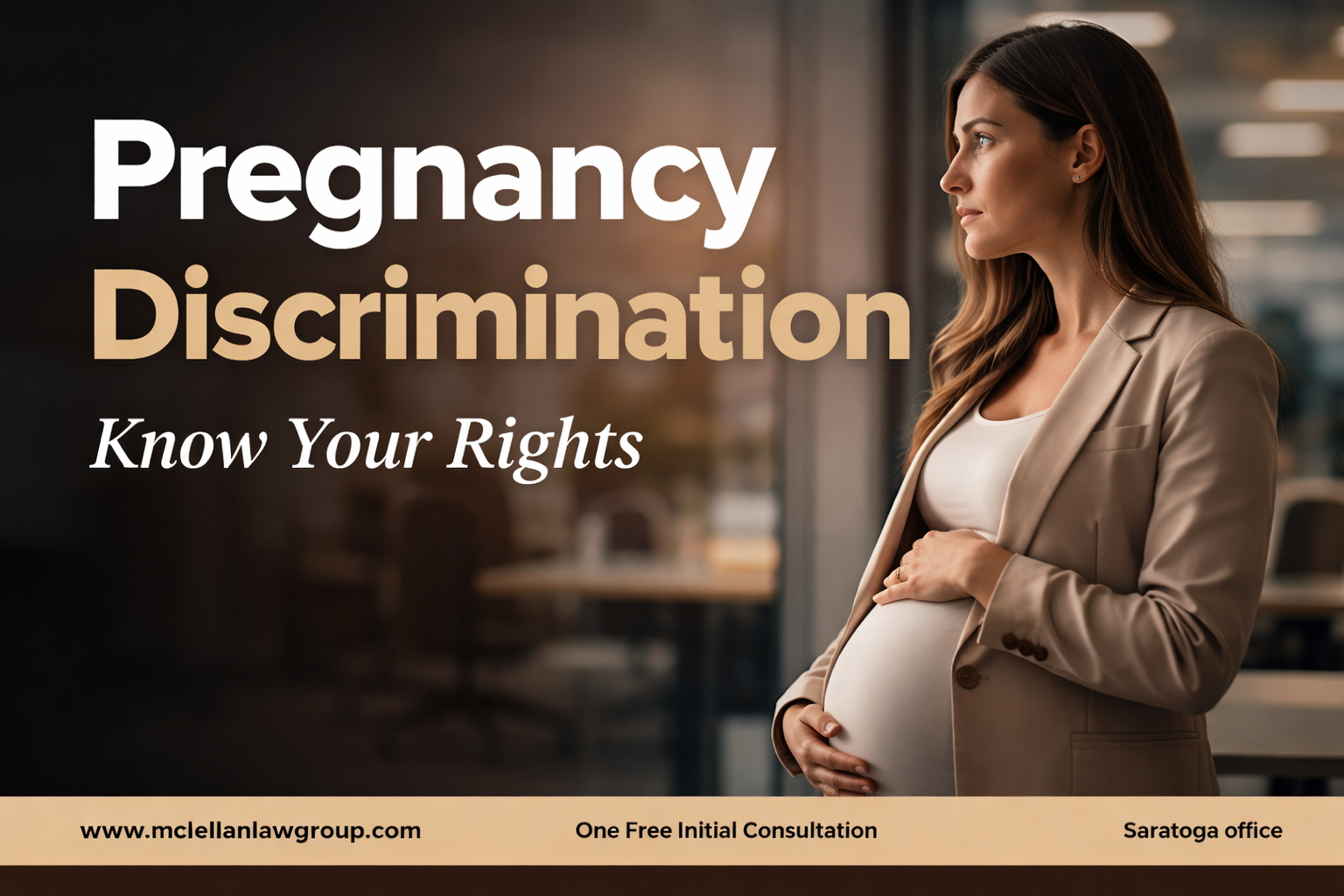
Pregnancy Discrimination in the California Workplace: Your FEHA Rights
California law gives pregnant employees some of the strongest workplace protections in the country. Here is what you need to know.
Bottom Line: California's Fair Employment and Housing Act (FEHA) makes it unlawful for employers to discriminate against employees because of pregnancy, childbirth, or related medical conditions. Pregnant employees are entitled to up to four months of disability leave, reasonable accommodations, and job protection. These rights apply to employers with five or more employees. (Gov. Code, § 12945; Needs verification.)
What California Law Protects
FEHA prohibits pregnancy discrimination through several overlapping protections. Under Government Code section 12945, it is an unlawful employment practice for an employer to do any of the following because of an employee's pregnancy, childbirth, or related medical condition:
- Refuse to hire, promote, or retain the employee
- Deny leave for a pregnancy-related disability
- Refuse a reasonable accommodation
- Refuse a transfer to a less strenuous or hazardous position when one is available
- Interfere with, restrain, or deny the exercise of pregnancy-related rights
These protections apply in addition to the general sex discrimination and disability discrimination provisions of FEHA under Government Code section 12940. (Gov. Code, §§ 12940, 12945; Needs verification.)
Pregnancy Disability Leave (PDL)
Under section 12945, employers must provide up to four months of leave to an employee who is disabled by pregnancy, childbirth, or a related medical condition. The leave does not need to be taken all at once. It covers any period during which the employee is unable to perform one or more essential functions of her job because of a pregnancy-related condition, as certified by a health care provider. (Gov. Code, § 12945, subd. (a)(1); Needs verification.)
Key details about PDL
- Duration: Up to four months (approximately 17.3 weeks for a full-time employee) per pregnancy, not per year.
- Accrued leave: Employees may choose to use accrued vacation leave during PDL. Employers may not require it.
- Notice: Employers may require reasonable advance notice of the anticipated start date and estimated duration of the leave.
- Health insurance: Employers must maintain and pay for group health coverage during PDL at the same level the employee would have had if continuously employed, for up to four months over a 12-month period. (Gov. Code, § 12945, subd. (a)(2); Needs verification.)
- Job protection: Upon return, the employee is entitled to reinstatement to the same or a comparable position.
CFRA Leave: Additional Bonding Time
The California Family Rights Act (CFRA), codified at Government Code section 12945.2, provides a separate right to up to 12 weeks of leave for bonding with a new child. CFRA leave is distinct from pregnancy disability leave. That means a California employee may be entitled to roughly seven months of combined protected leave: up to four months of PDL during the pregnancy and recovery period, followed by up to 12 weeks of CFRA leave for bonding. (Gov. Code, § 12945.2; Needs verification.)
CFRA applies to employers with five or more employees. The employee must have worked for the employer for at least 12 months and at least 1,250 hours in the 12 months before the leave begins. (Gov. Code, § 12945.2; Needs verification.)
Reasonable Accommodation
Beyond leave, FEHA requires employers to provide reasonable accommodation for pregnancy-related conditions when the employee requests it with the advice of a health care provider. Examples of reasonable accommodations include:
- Modified work duties or schedules
- More frequent breaks
- A temporary transfer to a less strenuous or hazardous position
- Providing a chair or stool at a workstation
- Temporary reassignment of tasks the employee cannot safely perform
An employer with a policy of transferring temporarily disabled employees to less strenuous or hazardous positions must extend the same option to a pregnant employee who requests it. Even without such a policy, the employer must grant a temporary transfer when it can reasonably be accommodated. The employer is not required to create a new position, discharge another employee, or transfer an employee with greater seniority. (Gov. Code, § 12945, subd. (a)(3); Needs verification.)
Common Forms of Pregnancy Discrimination
Pregnancy discrimination is not always obvious. It can take many forms, including:
- Termination or demotion after the employee announces a pregnancy or requests leave
- Refusal to accommodate a medical restriction, such as light duty, when similar accommodations are offered to other employees
- Retaliation for requesting pregnancy leave, accommodations, or time off for prenatal appointments
- Hostile comments about the employee's pregnancy, body, or ability to do her job
- Failure to reinstate the employee to the same or a comparable position after PDL
- Interference with the employee's attempt to use her leave rights, such as pressuring her to return early or discouraging her from taking leave at all
How to Protect Yourself
1. Notify your employer in writing
When you learn you are pregnant, provide written notice to your employer or HR department. Include the anticipated start date of any leave and any accommodation you need. Keep a copy of everything you send.
2. Get documentation from your health care provider
Ask your doctor for a written statement confirming the pregnancy-related condition, any work restrictions, the need for leave, and the expected duration. This documentation supports your accommodation request and your entitlement to PDL.
3. Document everything
Keep a record of every conversation, email, and decision related to your pregnancy and your employment. If your employer makes negative comments, denies a request, or changes your job duties or schedule after learning of the pregnancy, write it down with the date, time, and any witnesses.
4. Know the deadlines
If you believe your employer has discriminated against you because of pregnancy, you may file a complaint with the California Civil Rights Department (CRD). You generally have three years from the date of the discriminatory act to file. After exhausting your administrative remedies, you may file a lawsuit. (Gov. Code, § 12960; Needs verification.)
PDL vs. CFRA vs. FMLA: A Quick Comparison
| Feature | PDL | CFRA | FMLA |
|---|---|---|---|
| Duration | Up to 4 months | Up to 12 weeks | Up to 12 weeks |
| Purpose | Pregnancy-related disability | Bonding with new child (or other qualifying reasons) | Pregnancy, bonding, serious health conditions |
| Employer size | 5+ employees | 5+ employees | 50+ employees within 75 miles |
| Runs concurrently with FMLA? | Yes (for the pregnancy disability portion) | No (separate from PDL) | Yes (with PDL, not CFRA bonding) |
| Job protection? | Yes | Yes | Yes |
| Health insurance maintained? | Yes | Yes | Yes |
Free Download: Workplace Incident Documentation Worksheet
Use this worksheet to organize and preserve evidence of pregnancy discrimination, retaliation, or any workplace incident.
Frequently Asked Questions
How long is pregnancy disability leave in California?
Up to four months per pregnancy. The leave covers the period you are actually disabled by pregnancy, childbirth, or a related medical condition, as certified by your health care provider.
Does my employer have to hold my job during pregnancy leave?
Yes. Under FEHA, your employer must reinstate you to the same or a comparable position when you return from pregnancy disability leave, unless the position was eliminated for a legitimate business reason unrelated to your leave.
Can I take CFRA leave after pregnancy disability leave?
Yes. CFRA provides up to 12 weeks of additional leave to bond with a new child. This leave is separate from pregnancy disability leave, so a California employee may be entitled to roughly seven months of combined leave.
What if my employer has fewer than five employees?
FEHA generally applies to employers with five or more employees. If your employer has fewer than five employees, federal protections under the Pregnancy Discrimination Act may still apply if the employer has 15 or more employees. Smaller employers may still have obligations under other California statutes.
What should I do if my employer retaliates after I request pregnancy leave?
Document everything in writing, including emails, texts, and your own notes with dates and details. File a complaint with the California Civil Rights Department (CRD) or consult an employment attorney about your options.
Facing Pregnancy Discrimination at Work?
McLellan Law Group represents California employees in pregnancy discrimination, retaliation, and wrongful termination claims.
Schedule a ConsultationOr call us at (408) 963-7533
About the Authors
Claire Melehani, Esq.
Founding Partner
Founding partner at McLellan Law Group with extensive experience representing employees in wrongful termination, discrimination, and retaliation matters throughout Silicon Valley.
Steven McLellan, Esq.
Founding Partner
Founding partner at McLellan Law Group, whose practice focuses on employment law and business litigation throughout Silicon Valley and Santa Clara County.
Legal Disclaimer: This article is for general informational purposes only and does not constitute legal advice or create an attorney-client relationship. Consult a licensed California attorney for advice specific to your situation. McLellan Law Group, LLP · 20665 4th Street, Ste. 202, Saratoga, CA 95070 · (408) 963-7533