Intestate Succession in California: Who Inherits? - McLellan law Group
Trust & Probate | Published November 12, 2026 | McLellan Law Group, LLP
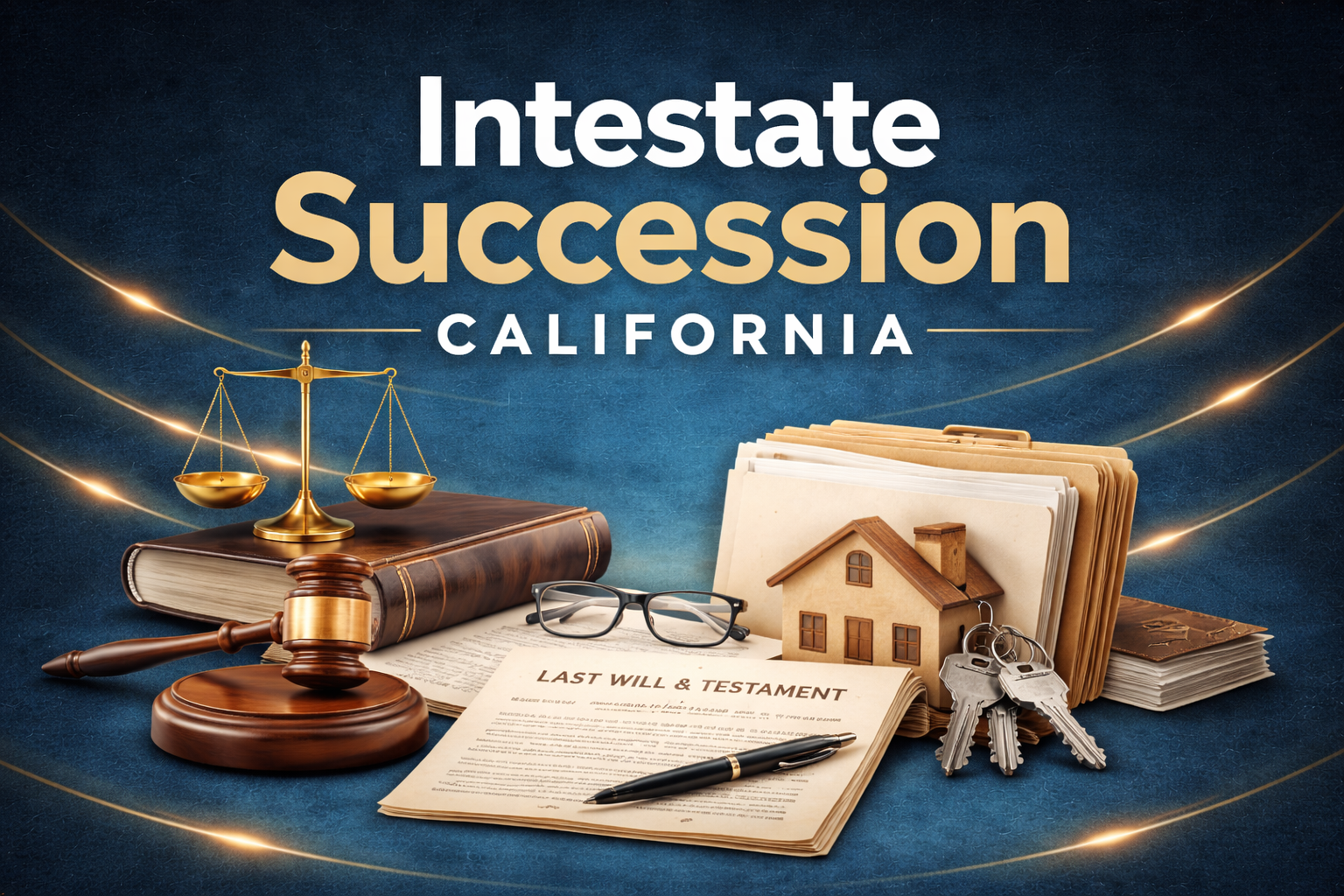
Intestate Succession in California: Who Inherits When There Is No Will
When someone dies without a will in California, state law determines who receives their property. The rules are rigid, and they may not match what the person would have wanted.
Bottom Line: If you die without a will in California, the Probate Code divides your estate among your closest living relatives in a fixed order: surviving spouse or domestic partner first, then children, then parents, then siblings, and so on. You have no say in who gets what, and the probate process is required for most estates.
What Is Intestate Succession?
"Intestate" means dying without a valid will. When that happens, California's intestate succession laws (Probate Code sections 6400 through 6414) control how the decedent's property is distributed. The court appoints an administrator to manage the estate through probate, and the administrator distributes assets according to statute rather than the decedent's wishes. (Prob. Code, sec. 6400. Needs verification.)
Intestate succession applies only to property that would have passed through a will. Certain assets pass outside of probate entirely, including property held in a living trust, life insurance proceeds with a named beneficiary, retirement accounts with a designated beneficiary, payable-on-death bank accounts, transfer-on-death securities, and property held in joint tenancy.
Community Property vs. Separate Property
California is a community property state, and this distinction is critical for intestate succession. The surviving spouse's share depends on whether the asset is community property or separate property.
Community property
Property acquired during the marriage generally belongs equally to both spouses. Under intestate succession, the decedent's one-half interest in community property passes entirely to the surviving spouse or registered domestic partner. (Prob. Code, sec. 6401, subd. (a). Needs verification.)
Separate property
Property acquired before marriage, or received as a gift or inheritance during marriage, is separate property. The surviving spouse's share of separate property depends on which other relatives survive the decedent.
Who Inherits: The Order of Priority
California law establishes a clear hierarchy. If no one in a higher category survives, the estate passes to the next category.
| Who Survives the Decedent | Community Property | Separate Property |
|---|---|---|
| Spouse only (no children, parents, or siblings) | All to spouse | All to spouse |
| Spouse + one child (or descendants of one deceased child) | All to spouse | 1/2 to spouse, 1/2 to child |
| Spouse + two or more children (or their descendants) | All to spouse | 1/3 to spouse, 2/3 split among children |
| Spouse + parent(s) but no children | All to spouse | 1/2 to spouse, 1/2 to parent(s) |
| Spouse + sibling(s) but no children or parents | All to spouse | 1/2 to spouse, 1/2 to sibling(s) |
| Children only (no spouse) | N/A | All to children equally |
| No spouse or children | N/A | Parents, then siblings, then more distant kin |
Source: Prob. Code, secs. 6401, 6402. Needs verification. This table is a simplified summary; consult an attorney for your specific situation.
When there are no close relatives
If the decedent has no surviving spouse, children, parents, or siblings, the estate passes to increasingly distant relatives in this order: grandparents, aunts and uncles, cousins, and so on. (Prob. Code, sec. 6402. Needs verification.) If no living relative can be found, the estate "escheats" to the State of California. (Prob. Code, sec. 6800. Needs verification.)
Special Rules That Affect Inheritance
The 120-hour survivorship requirement
An heir must survive the decedent by at least 120 hours (five days) to inherit. If the heir dies within that window, they are treated as having predeceased the decedent. (Prob. Code, sec. 6403. Needs verification.)
Representation (per stirpes)
If one of the decedent's children has already died but left children of their own (the decedent's grandchildren), those grandchildren step into their parent's place and split that parent's share. (Prob. Code, sec. 6402. Needs verification.)
Half-siblings
Half-siblings inherit the same share as full siblings under California law. (Prob. Code, sec. 6406. Needs verification.)
Adopted children
Adopted children are treated exactly the same as biological children for inheritance purposes. (Prob. Code, sec. 6450. Needs verification.)
Stepchildren and foster children
Stepchildren and foster children generally do not inherit under intestate succession. A limited exception exists if the relationship began during the child's minority and continued throughout the parties' lifetimes, and the decedent would have adopted the child but for a legal barrier. (Prob. Code, sec. 6454. Needs verification.)
Children born after death
A child conceived before the decedent's death but born afterward inherits as though born during the decedent's lifetime. (Prob. Code, sec. 6407. Needs verification.)
The "slayer rule"
A person who feloniously and intentionally kills the decedent is disqualified from inheriting any part of the estate. (Prob. Code, sec. 250. Needs verification.)
Immigration status
A person's citizenship or immigration status does not affect their right to inherit under California law. (Prob. Code, sec. 6411. Needs verification.)
The Intestate Probate Process
When someone dies without a will, the estate typically must go through probate. The basic steps include:
- Confirming that no valid will exists.
- Filing a petition for probate in the county where the decedent lived.
- The court appointing an administrator (usually a close family member).
- Notifying heirs and creditors.
- Filing an inventory and appraisal of estate assets.
- Paying valid debts, expenses, and taxes.
- Distributing the remaining assets according to the intestacy statutes.
- Filing a final accounting and closing the estate.
Probate can take anywhere from several months to over a year, and fees are set by statute based on the estate's gross value. For more on costs, see our article on how much probate costs in California.
Why Having a Will or Trust Matters
Intestate succession follows a rigid formula. It does not account for:
- Close friends or unmarried partners you want to provide for.
- Charitable organizations you support.
- Children or family members with special needs who require a structured inheritance.
- Specific items of sentimental value you want to leave to particular people.
- Minimizing probate costs and delays.
A properly drafted will gives you control over who receives your property and in what proportions. A revocable living trust can go further by allowing your estate to avoid probate altogether, keeping your affairs private and getting assets to your loved ones more quickly.
For families: If a loved one has passed away without a will, the intestate succession rules determine who is entitled to the estate. An attorney can help you understand your rights, petition the court for appointment as administrator, and guide the estate through probate.
Frequently Asked Questions
Does a surviving spouse automatically inherit everything in California?
Not necessarily. The surviving spouse receives all of the decedent's community property, but their share of separate property depends on which other relatives survive the decedent. If there are children, the spouse may receive only one-third or one-half of the separate property.
Do domestic partners have the same inheritance rights as spouses?
Yes. California treats registered domestic partners the same as married spouses for intestate succession purposes.
Can I inherit from a parent who never acknowledged me?
Establishing a parent-child relationship for inheritance purposes can be complex. California law provides several paths, including genetic testing, acknowledgment, and court proceedings. Consulting an attorney is advisable.
What happens if my spouse and I die at the same time?
Under the 120-hour survivorship rule, if neither spouse can be shown to have survived the other by at least 120 hours, each spouse's property is distributed as if the other had predeceased them. (Prob. Code, sec. 6403. Needs verification.)
How long does intestate probate take in California?
Most intestate probates take between nine months and two years, depending on the size and complexity of the estate, whether any disputes arise, and the court's calendar. Estates with contested claims or hard-to-value assets may take longer.
Need Help Navigating an Intestate Estate?
Our trust and probate attorneys help California families understand their inheritance rights, petition for estate administration, and resolve disputes.
Schedule a ConsultationOr call us at (408) 963-7533
About the Authors
Claire Melehani, Esq.
Founding Partner
Founding partner at McLellan Law Group with experience advising California families on estate administration, trust disputes, and probate proceedings throughout Silicon Valley.
Steven McLellan, Esq.
Founding Partner
Founding partner at McLellan Law Group, whose practice focuses on trust litigation and civil disputes throughout Silicon Valley and Santa Clara County.
Legal Disclaimer: This article is for general informational purposes only and does not constitute legal advice or create an attorney-client relationship. Consult a licensed California attorney for advice specific to your situation. McLellan Law Group, LLP · 20665 4th Street, Ste. 202, Saratoga, CA 95070 · (408) 963-7533