How Long Does Probate Take in California? | McLellan Law Group
Trust & Probate | Published October 22, 2026 | McLellan Law Group, LLP
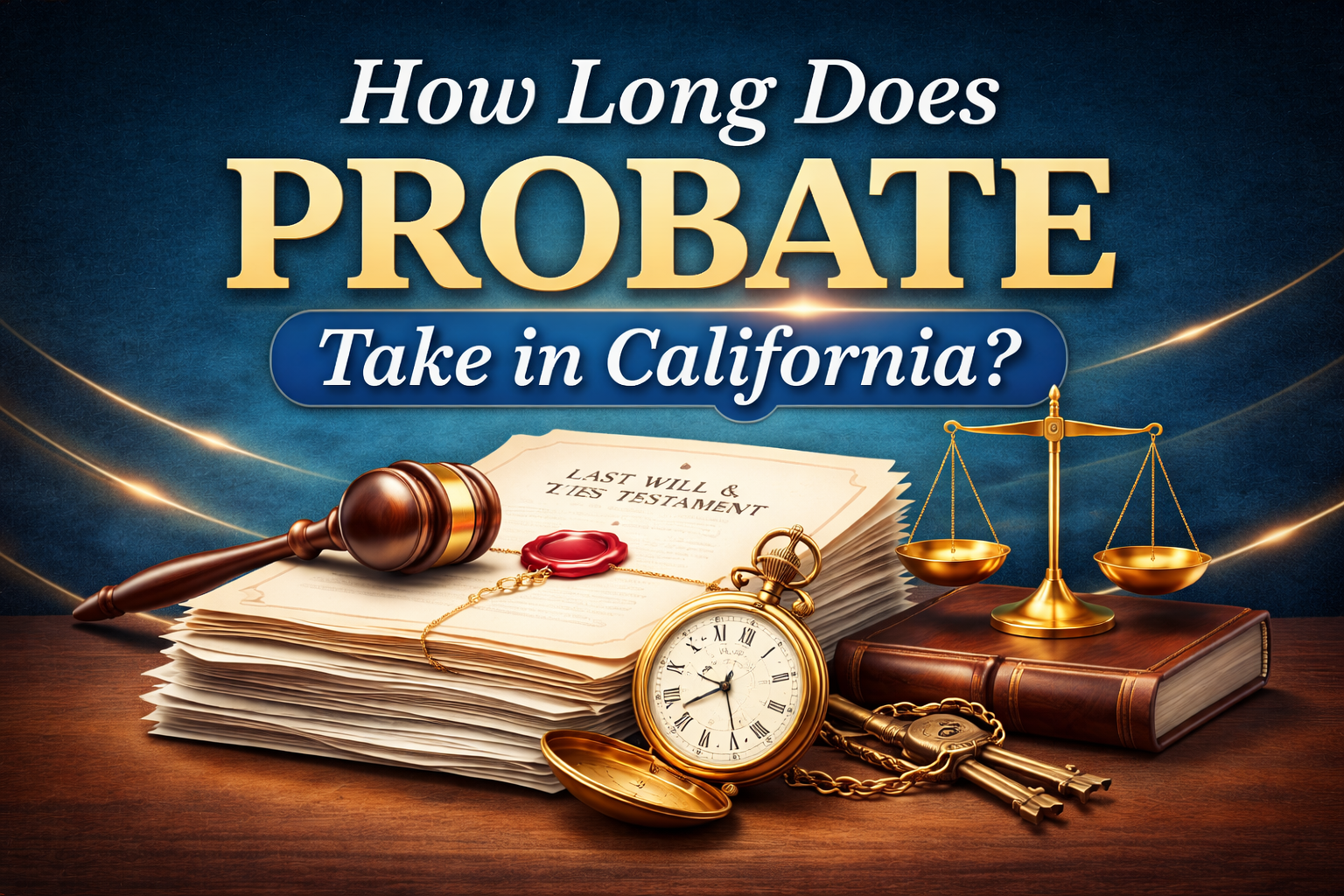
How Long Does Probate Take in California?
Most California estates take 12 to 24 months to close — and often longer. Here's what drives the clock, what creates delays, and what your family can realistically expect.
When a loved one dies and leaves an estate that must go through probate, one of the first questions families ask is: How long is this going to take? The honest answer is rarely what people want to hear.
In California, probate is a court-supervised process for transferring a deceased person's assets to their heirs and paying their debts. It is procedurally detailed, governed by statutory deadlines, and subject to court scheduling — all of which add up to a timeline that few families find short.
The general range is 12 to 24 months for a straightforward estate. Complex estates, contested matters, or cases involving real property, creditor disputes, or tax issues can stretch to three years or more.
This article explains the stages of California probate, the realistic timelines at each step, and the most common reasons estates take longer than families expect.
Why California Probate Takes So Long
California probate is governed primarily by the California Probate Code. The process is not simply paperwork — it is a formal legal proceeding in the Superior Court with required notice periods, creditor claim windows, and judicial approvals at multiple stages.
Unlike some states, California does not have an expedited or simplified probate process for most estates. (Small estates under $184,500 in personal property may qualify for a simplified affidavit procedure, but real property above that threshold typically requires full probate.) The court system itself also operates on its own schedule, which in many California counties means hearings are set weeks or months out.
Key threshold (2026): California probate is generally required when a decedent's estate includes assets — typically real property or financial accounts — that exceed $184,500 in gross value and are not held in trust or transferred by other means (joint tenancy, beneficiary designation, etc.). This threshold adjusts periodically. Verify current threshold with counsel.
The California Probate Timeline: Stage by Stage
Stage 1: Filing the Petition (Weeks 1–8)
The process begins when the executor named in the will — or, if there is no will, a proposed administrator — files a petition for probate with the Superior Court in the county where the decedent lived. The petition includes the will (if any), a death certificate, and identifying information about the estate.
Once filed, the court sets a hearing date. In most California counties, that first hearing is typically scheduled 4 to 8 weeks after filing, though some counties have longer backlogs. San Jose, San Francisco, and Los Angeles probate courts have historically seen significant scheduling delays.
Before the hearing, notice must be published in a local newspaper for a specified period and served on known heirs and creditors. These notice requirements are not optional — they are statutory prerequisites to the court's authority to proceed.
Stage 2: Appointment of Personal Representative and Letters (Weeks 8–12)
At the initial hearing, the court formally appoints the executor or administrator and issues Letters Testamentary (if there is a will) or Letters of Administration (if there is not). These letters are the legal document that gives the personal representative authority to act on behalf of the estate — to marshal assets, open estate bank accounts, communicate with financial institutions, and manage estate property.
This stage is typically completed within 8 to 12 weeks of the original filing, assuming no objections to the appointment are raised. Contested appointments — where multiple heirs seek to serve, or creditors or heirs challenge the proposed representative — add significant time.
Stage 3: Creditor Claim Period (4 Months)
Once Letters are issued, a mandatory creditor claim period begins. Under California Probate Code section 9100, general creditors have four months from the date Letters are issued — or 60 days from when they receive notice of the proceedings, whichever is later — to file claims against the estate.
This four-month window cannot be shortened. The estate cannot be closed and assets cannot be distributed to beneficiaries until this period has run and all creditor claims have been addressed. During this time, the personal representative inventories the estate's assets, obtains appraisals through a Probate Referee appointed by the court, and prepares the Inventory and Appraisal (Form DE-160).
Stage 4: Asset Administration and Debt Payment (Months 4–12+)
After the creditor claim period closes, the personal representative must pay valid debts, resolve disputed creditor claims, and manage estate assets — collecting income, paying taxes, maintaining real property, and liquidating assets as needed to satisfy debts and costs of administration.
If the estate owns real property that must be sold, California requires court confirmation of the sale in most circumstances unless the personal representative has been granted Independent Administration of Estates Act (IAEA) authority. A court-confirmed sale adds a hearing, a required overbid process, and additional delay — often 2 to 4 additional months just for the sale.
Estates with federal or California estate tax issues face additional complexity. California does not have a separate state estate tax (it follows the federal system), but estates over the federal exemption ($13.61 million in 2024, subject to change) require a federal estate tax return with a nine-month filing deadline — and tax clearance may be required before the estate can close.
Stage 5: Petition for Final Distribution (Months 12–18+)
Once debts are paid and assets are administered, the personal representative files a Petition for Final Distribution, an accounting of all estate transactions, and a proposed distribution to the beneficiaries. The court must approve this accounting and distribution at a noticed hearing.
If any beneficiary objects to the accounting — disputes over fees, allegations of mismanagement, disagreements over asset values — the court will set the matter for further hearing. These disputes can add months or, in contested cases, years to the timeline.
Once the court approves the final distribution, the personal representative transfers assets to the beneficiaries, files receipts with the court, and the estate is formally closed.
California Probate Timeline Summary
| Stage | Typical Duration | What Drives It |
|---|---|---|
| File petition & first hearing | 4–8 weeks | Court scheduling; notice requirements |
| Letters issued | Weeks 8–12 | Court approval; contested appointments add time |
| Creditor claim period | 4 months (mandatory) | Statutory; cannot be shortened |
| Asset admin & debt payment | Months 4–12+ | Property sales; tax issues; creditor disputes |
| Petition for final distribution | Months 12–18+ | Court scheduling; accounting objections |
| Total (simple estate) | 12–18 months | |
| Total (complex/contested) | 2–4+ years |
What Makes California Probate Take Longer
Several factors consistently extend timelines beyond the baseline:
Real Property Without IAEA Authority
When a personal representative must sell real property and lacks Independent Administration of Estates Act authority, every sale requires court confirmation. The overbid process — where any party can outbid the original buyer at a court hearing — adds uncertainty and delay. Executors should request full IAEA authority at the outset when possible.
Out-of-State or Foreign Property
If the decedent owned real property in multiple states, each state may require its own ancillary probate proceeding. Foreign property adds further complication. Each ancillary proceeding runs on that jurisdiction's timeline — independently of the California case.
Will Contests and Family Disputes
A will contest — a challenge to the validity of the will itself — is filed in the probate court and can halt distribution entirely until resolved. Similarly, disputes among beneficiaries over the accounting, the personal representative's conduct, or the interpretation of ambiguous bequest language all require noticed hearings and, potentially, trial.
Missing or Unlocatable Heirs
When heirs cannot be located after diligent search, the personal representative may need to petition the court for special procedures, including potentially escheating unclaimed shares to the state. This adds both time and cost.
Creditor Disputes
A creditor who files a claim the personal representative rejects has the right to bring an action against the estate. If that dispute goes to litigation, it runs on the civil litigation calendar — entirely separate from the probate proceedings.
Court Backlogs
California probate courts in high-population counties have historically operated with significant scheduling backlogs. In Santa Clara County (where McLellan Law Group primarily practices), probate hearings can be set 6 to 10 weeks or more in advance. Every hearing in the process — the initial petition, intermediate matters, and the final distribution — adds scheduling time.
Bottom line: A simple California estate with a willing personal representative, no real property issues, no creditor disputes, and a cooperative family can close in 12 to 15 months. Any deviation from that — contested matters, real property, tax issues, or court backlogs — pushes the timeline meaningfully longer. Three-year probate proceedings are not rare for complex estates.
Can Probate Be Avoided Altogether?
Yes — and for many California families, this is the better path. Assets held in a living trust, joint tenancy property, accounts with named beneficiaries (retirement accounts, life insurance, payable-on-death accounts), and community property with right of survivorship all transfer outside of probate entirely.
A properly funded revocable living trust is the most comprehensive tool for probate avoidance in California. When all significant assets are titled in the trust or have beneficiary designations directing them to the trust, the estate can often be administered by the successor trustee without any court involvement — typically in a matter of months, not years.
If you are currently administering an estate with both trust assets and probate assets, the two processes run in parallel: the trustee administers the trust; the personal representative handles the probate estate. Understanding which assets fall into which category is an early priority in estate administration.
What Families Can Do to Avoid Delays
While many timelines are driven by statutory requirements and court scheduling, families and personal representatives can take concrete steps to avoid self-inflicted delays:
- File promptly. Delaying the initial petition wastes time and can complicate asset management.
- Request IAEA authority. Full Independent Administration of Estates Act authority eliminates many court-confirmation requirements and allows the personal representative to act without a hearing for most transactions.
- Get the inventory done early. Working with the Probate Referee to complete the Inventory and Appraisal as soon as the creditor claim period begins avoids a bottleneck at the back end.
- Keep meticulous records. The final accounting must account for every estate transaction. Sloppy bookkeeping at the start becomes a problem at the final distribution hearing.
- Address creditor claims promptly. Rejected claims that linger without resolution create uncertainty and can delay closing.
- Engage an experienced probate attorney early. Most procedural mistakes in probate happen at the beginning — the wrong petition, missing notices, or failure to identify all estate assets.
Administering a California Estate?
McLellan Law Group represents personal representatives, trustees, and beneficiaries in California probate and trust administration. We handle the procedural requirements so families can focus on what matters.
Schedule a ConsultationOr call us at (408) 963-7533
About the Authors
Claire Melehani, Esq.
Trust and probate attorney at McLellan Law Group with experience advising California families on estate administration, trust disputes, and probate proceedings throughout Silicon Valley.
Steven McLellan, Esq.
Founding attorney at McLellan Law Group, focusing in trust litigation and civil disputes throughout Silicon Valley and Santa Clara County.
Legal Disclaimer: This article is for general informational purposes only and does not constitute legal advice or create an attorney-client relationship. Consult a licensed California attorney for advice specific to your situation. McLellan Law Group, LLP · 20665 4th Street, Ste. 202, Saratoga, CA 95070 · (408) 963-7533