A fence a few feet over the line. A shared driveway used for decades without a written agreement. A neighbor's tree roots crossing onto your property. Easement and encroachment disputes are among the most common — and most emotionally charged — real estate conflicts in Silicon Valley, where dense development and older parcel lines frequently produce boundary uncertainty. Knowing your rights, and the difference between the two types of disputes, is the first step toward resolving them.
Easements vs. Encroachments: What's the Difference?
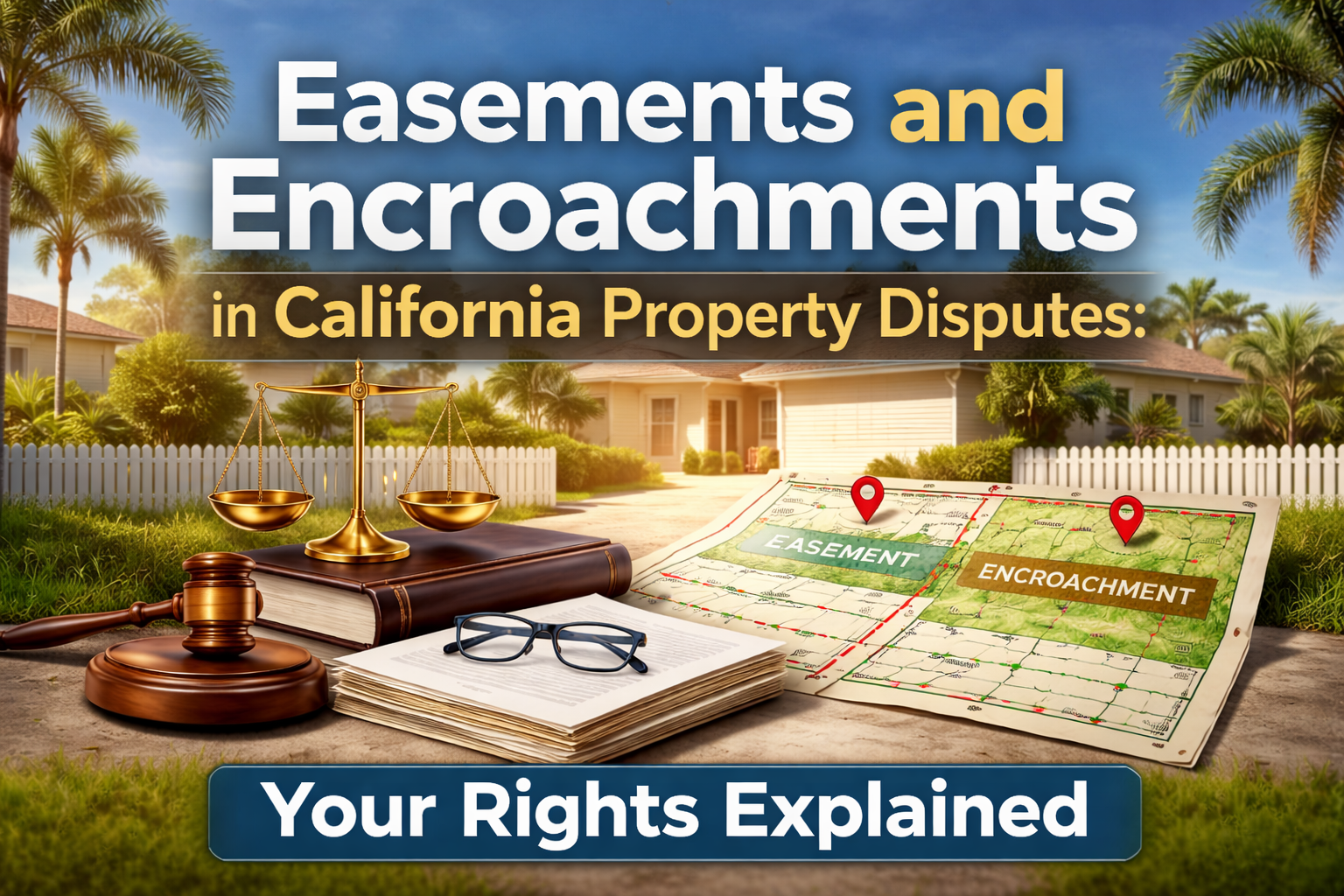
An easement is a legal right to use a portion of another person's land for a specific, limited purpose — common examples include a shared driveway, a utility line, or a pathway providing access to a landlocked parcel. The property remains owned by the underlying landowner, but the easement holder has an enforceable right to the specified use. An encroachment, by contrast, is a physical structure or improvement — a fence, a wall, an overhanging roofline, landscaping — that extends onto a neighboring property without any legal right to be there.
Concrete example: A Los Gatos homeowner has a survey conducted before a remodel and discovers that a neighbor's fence, driveway, and portion of a shed sit roughly four feet onto the homeowner's property — and have for over twenty years. This is an encroachment, not an easement, because there was never any granted right to that use; the resolution options range from negotiated removal to a claim that the encroaching party has acquired a prescriptive right, depending on how the twenty years of use unfolded.
"A survey resolves what an argument over a fence line cannot. Before any legal strategy, establish where the boundary actually is."
How Easements Are Created in California
California recognizes several ways an easement can be legally created. An express easement is created by a written agreement or grant, typically recorded against the property title. An easement by implication may arise when a single parcel is divided and the circumstances of the division make clear that continued use of an existing pathway, driveway, or utility line was intended by both parties, even without an express written grant. An easement by necessity arises when a parcel would otherwise have no legal access to a public road.
Recorded easements should appear in a title report during any real estate transaction — a careful review of the preliminary title report before purchasing property in Silicon Valley can reveal existing easements affecting a parcel's use and value.
Prescriptive Easements: Use Without Permission
A prescriptive easement can arise even without any agreement between the parties. California law allows a party to acquire an easement by using another's property openly, continuously, and in a manner hostile to the owner's interest — meaning without the owner's permission — for a period of five years, the same period applicable to adverse possession claims. Unlike adverse possession, a prescriptive easement claimant does not need to pay property taxes on the land, since the claim is limited to a right of use rather than ownership.
A property owner who wishes to prevent a prescriptive easement from arising can do so by granting explicit written permission for the use — since permissive use, by definition, is not hostile and cannot ripen into a prescriptive right.
Resolving an Encroachment Dispute
The appropriate resolution for an encroachment depends heavily on several factors: how long the encroachment has existed, whether it was built in good faith or bad faith, the cost and disruption of removal, and the relative harm to each party. Most encroachment disputes in the Bay Area are ultimately resolved through negotiation — options include removal of the encroaching structure, compensation to the affected owner, or a formal boundary line agreement or negotiated easement that resolves the dispute going forward and can be recorded against both properties.
Where a structure has encroached for many years in apparent good faith, and removal would be significantly more burdensome to the encroaching party than the harm to the affected owner, courts may apply the relative hardship doctrine to allow the encroachment to remain in exchange for fair compensation, rather than ordering removal.
Litigation Options: Injunctions, Quiet Title, and Damages
When negotiation fails, several litigation tools are available. An action for injunctive relief seeks a court order requiring removal of an encroachment. A quiet title action asks the court to formally determine and declare the boundaries and rights of the parties, resolving disputed claims to an easement or disputed portion of land. A damages claim may be appropriate where the encroachment has caused measurable harm, such as lost use of property or diminished value.
Before pursuing any of these options, a professional licensed survey establishing the true boundary line is essential — disputes are frequently resolved, or at minimum clarified, once an accurate survey is in hand. McLellan Law Group represents clients in Saratoga, San Jose, Cupertino, Los Gatos, and throughout Silicon Valley and Santa Clara County in easement and encroachment disputes.
Frequently Asked Questions
An easement is a legal right to use another's land for a specific purpose, such as access or utilities. An encroachment is a physical structure that extends onto a neighbor's property without permission or legal right.
A prescriptive easement arises when a party uses another's property openly, continuously, and hostile to the owner's interest, without permission, for a period of five years — analogous to the statute of limitations for adverse possession.
Options include negotiating removal or a boundary line agreement, seeking compensation, or pursuing an injunction or quiet title action, depending on how long the encroachment existed and whether it was made in good or bad faith.
In some cases, courts apply the relative hardship doctrine and allow a long-standing, good-faith encroachment to remain in exchange for compensation to the property owner, rather than ordering removal.
Yes — a professional licensed survey is typically the first and most important step in any easement or encroachment dispute, establishing the true boundary line before any legal or negotiated resolution is pursued.
About the Authors
ADVERTISING MATERIAL DISCLAIMER — This communication is an advertisement for legal services by McLellan Law Group, LLP. The content is intended for informational purposes only and should not be construed as legal advice. Each case and its facts are unique, and the outcomes mentioned in this advertisement, if any, are not guarantees of future results. Responsible Lawyer: Claire Melehani, Esq., 20665 4th Street, Suite 202, Saratoga, CA 95070.