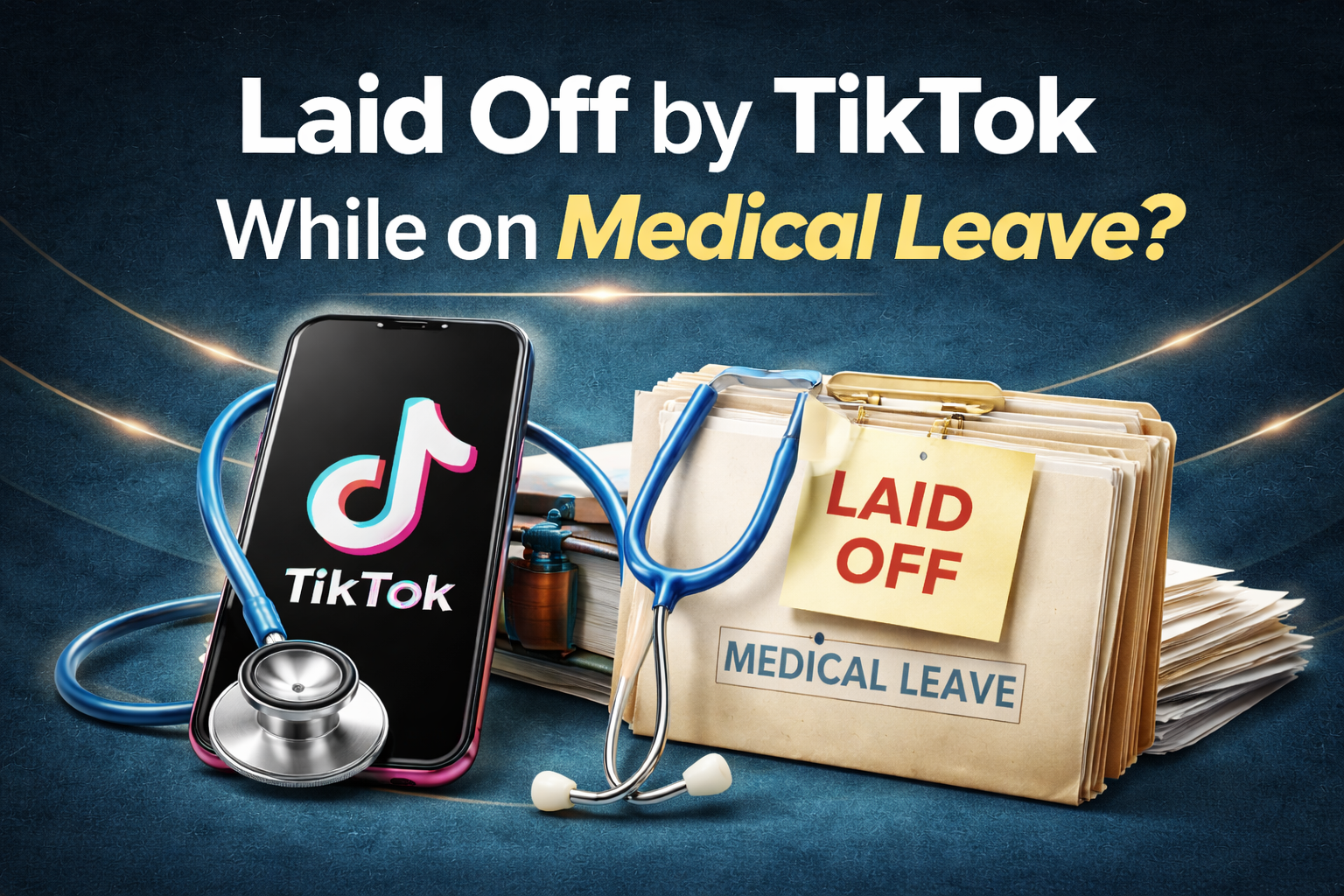
Were You Laid Off by TikTok While on Medical Leave? Your Rights Under California Law
Employers can conduct legitimate layoffs — but they cannot use a restructuring as cover to push out employees because they took or requested protected medical leave. If you were laid off by TikTok while on CFRA or FMLA leave, or shortly after requesting it, that timing may matter more than you think.
If you were part of a TikTok layoff while you were on medical leave, while your leave request was pending, or shortly after you returned from leave, you may have legal claims that go beyond whatever severance the company offered. California's Family Rights Act (CFRA) and the federal Family and Medical Leave Act (FMLA) provide strong protections against exactly this kind of adverse action — and courts have shown a willingness to let these cases proceed when the facts support them.
This article explains what those protections cover, what makes a layoff legally problematic when it coincides with protected leave, and what steps to take if you believe your situation warrants a closer look.
TikTok's Ongoing U.S. Workforce Reductions
TikTok has conducted multiple rounds of layoffs across its U.S. operations over the past 18 months, touching trust and safety, e-commerce, music, and gaming divisions. In August 2026, TikTok confirmed it is closing its entire Nashville office, laying off all 250 employees, effective October 5, 2026. Earlier rounds affected Los Angeles-based operations as well as the company's Dublin and London offices globally.
The company has framed these reductions as part of a broader global restructuring tied to its shift toward AI-driven operations and changing regulatory pressures following its joint venture restructuring in early 2026.
Mass layoffs during corporate restructuring are generally lawful. The question is not whether TikTok can reduce its workforce. The question is whether the company selected specific employees for layoff — at least in part — because those employees were on medical leave or had recently requested it. That is where California and federal law draw a firm line.
The company has also faced prior employment-related litigation. In Puris v. TikTok , a federal court denied TikTok's motion to dismiss discrimination and retaliation claims in January 2025, allowing those claims to proceed. That ruling, while separate from medical leave issues, reflects judicial willingness to scrutinize how the company handles employee disputes.
What California Law and Federal Law Actually Protect
CFRA: California's Family Rights Act
California's Family Rights Act, codified at Government Code section 12945.2, provides up to 12 weeks of job-protected, unpaid leave per year for eligible employees dealing with a serious health condition, caring for a family member, or bonding with a new child. CFRA applies to employers with five or more employees — a significantly lower threshold than the federal FMLA's 50-employee minimum. If TikTok employs five or more people within 75 miles of your worksite, CFRA almost certainly applied to you.
CFRA explicitly prohibits both retaliation and interference with leave rights. Government Code section 12945.2(k) provides that it is unlawful for an employer to "refuse to hire, or to discharge, fine, suspend, expel, or discriminate against, any individual because of" the exercise of CFRA rights, or to "interfere with, restrain, or deny the exercise of, or the attempt to exercise, any right" provided under the statute.
FMLA: The Federal Floor
The federal Family and Medical Leave Act, 29 U.S.C. § 2601 et seq., provides similar job-protected leave protections and applies to employers with 50 or more employees. It prohibits both retaliation (29 U.S.C. § 2615(a)(2)) and interference with FMLA rights (29 U.S.C. § 2615(a)(1)). California's CFRA generally provides broader protections than FMLA and, in most California employment contexts, is the more powerful of the two statutes.
FEHA's Anti-Retaliation Provision
California's Fair Employment and Housing Act (FEHA), Government Code section 12940(h), independently prohibits retaliation against employees who request or take protected medical leave. An employee who was laid off in circumstances suggesting their leave was a motivating factor may have claims under FEHA in addition to CFRA and FMLA — and FEHA allows a prevailing employee to recover reasonable attorney's fees and costs, subject to the court's determination.
What Employers Can Do — and What They Cannot
Neither CFRA nor FMLA makes employees on leave immune from layoffs. If a company-wide restructuring would have eliminated your position regardless of your leave status, the layoff may be lawful even if it occurs while you are out. The burden, however, falls on the employer to demonstrate that the decision was truly independent of the leave.
What employers cannot do is use a restructuring as a vehicle to select, for layoff, employees who are inconvenient because of their leave — because they took it, because they requested it, or because their condition created operational challenges. The law does not require the employer to write "terminated because of medical leave" in any document. Courts look at the totality of the evidence, including:
- The timing between the leave request or return and the layoff decision
- Whether similarly situated employees who were not on leave were retained in the same reduction
- Whether the stated reason for the selection shifted or became more elaborate over time
- Whether the employee received positive performance reviews before the leave
- Whether the position was truly eliminated or quickly reassigned to someone else
- Whether the employee was replaced by someone outside a protected class or without a medical condition
- Any comments by managers referencing the leave, the employee's return date, or operational inconvenience caused by the absence
The timing question matters most. There is no fixed rule about how close in time a layoff must be to a leave event to trigger suspicion. Courts evaluate the full picture. A layoff the day after returning from leave is different from a layoff six months later — but neither is automatically lawful or unlawful. The analysis depends on what else the evidence shows. An employment attorney can evaluate your specific timeline against California's standards.
What to Do If This Describes Your Situation
Every severance agreement TikTok offers will include a broad release of all employment claims — including CFRA, FMLA, and FEHA claims. Once signed, that release is generally enforceable and difficult to undo. If you are 40 or older and the layoff was part of a group reduction, the Older Workers Benefit Protection Act (OWBPA) requires at least 45 days to review and 7 days to revoke after signing. A valid release can waive valuable claims, which is why the agreement should be reviewed carefully before signing.
Write down the exact dates you requested leave, when leave was approved, when it began, when it was scheduled to end, and when you received notice of the layoff. If any manager communicated about your leave status, your return date, or workload concerns related to your absence, note those conversations with as much detail as you can recall. Contemporaneous notes carry more weight than reconstruction months later.
Before your company email and systems are deactivated, preserve any communications related to your leave, your layoff notification, and your performance history. Request your personnel file in writing under Labor Code section 1198.5 and your wage statements under Labor Code section 226. Before transferring any company documents, consult an employment attorney about what you are permitted to retain — particularly if the materials contain proprietary, confidential, or privileged information.
If you know of coworkers in similar roles who were retained while you were laid off, note their names, their positions, and to the extent you know it, whether they had recently taken or requested leave. Comparative employee data is among the most powerful evidence in a medical leave retaliation case. You do not need to have all of this information before consulting an attorney — discovery can surface it — but any information you have now is worth preserving.
California's statutes of limitations are real. For CFRA and FEHA claims, you generally must file a complaint with the California Civil Rights Department within three years of the adverse action. For FMLA claims, the period is generally two years (or three years for willful violations). Multiple clocks may run simultaneously. Consulting an attorney before those deadlines pass — and before you sign any release — gives you the most complete set of options.
Evidence That Supports a Medical Leave Retaliation Claim
Gather and preserve as much of this as possible
- Your original leave request and any written approval from HR
- Any emails or messages from managers referencing your leave, your return date, or coverage concerns
- Your performance reviews from the past two to three years, particularly any that predate your leave
- Your layoff notification letter — the date it was issued relative to your leave start, leave end, or return date
- Any documentation of the layoff criteria TikTok used to select employees
- Information about similarly situated coworkers who were retained and did not have pending or recent leave
- Any communications that changed in tone after your leave began — increased scrutiny, altered feedback, new performance concerns
- Copies of any WARN Act notice you received, and whether its content complied with California's SB 617 2026 requirements
Frequently Asked Questions
An employer can conduct a legitimate layoff that includes someone on medical leave, but only if that person would have been selected regardless of their leave status. What employers cannot do is use a restructuring as cover to push out employees specifically because they took or requested protected leave under CFRA or FMLA. If the timing of your layoff coincides closely with your leave, California law may support a retaliation or interference claim.
The federal FMLA provides up to 12 weeks of job-protected unpaid leave and applies to employers with 50 or more employees. California's CFRA provides similar protections and applies to employers with 5 or more employees — a much lower threshold. CFRA also covers a broader range of family members. If TikTok employed five or more people within 75 miles of your worksite, CFRA likely applied to you even if FMLA did not.
Under both CFRA and FMLA, employers are prohibited not only from retaliating against employees who take protected leave, but also from interfering with, restraining, or denying the exercise of leave rights. Interference can include discouraging you from taking leave, conditioning your job security on not taking leave, or timing an adverse action to coincide with your leave request or return.
No employer will put "terminated because of medical leave" in writing. What you look for is circumstantial evidence: close timing between your leave request or return and the adverse action; positive performance reviews before your leave; different treatment compared to similarly situated coworkers who did not take leave; shifting or inconsistent explanations for why you were selected; and whether your position was truly eliminated or quickly reassigned to someone else. An employment attorney can evaluate those facts against California's legal standards.
Available remedies may include lost wages and benefits, front pay if reinstatement is not practical, reinstatement to your position or an equivalent one, and emotional distress damages under FEHA's anti-retaliation provisions. FEHA allows a prevailing employee to recover reasonable attorney's fees and costs, subject to the court's determination. The full range of remedies available to you depends on which statutes apply and the specific facts of your case.
It depends on the specific language of the release, when you signed it, and whether the agreement complied with applicable requirements. If you are 40 or older and the layoff was part of a group reduction, OWBPA requires both a 45-day review period and a 7-day revocation window after signing. A release that did not include these disclosures, or that was presented in a way that was not knowing and voluntary, may be challengeable. Consult an employment attorney as soon as possible to evaluate whether any options remain.
Your Timeline May Matter More Than You Think
Most employees who are laid off during a corporate restructuring accept the employer's framing at face value. The company is restructuring. The position was eliminated. Here is your severance package. Sign here.
For employees whose layoff coincided with medical leave, that framing deserves scrutiny before you accept it — and certainly before you sign a release. California law does not allow companies to use legitimate restructuring language as a shield for decisions that were, in whole or in part, driven by an employee's protected activity. The fact that TikTok is a large company undergoing genuine change does not make every individual layoff decision lawful.
If you were laid off by TikTok while on medical leave, while your leave request was pending, or within a period that feels suspiciously connected to your leave, we want to hear from you. At McLellan Law Group, LLP, our employment attorneys represent California employees in medical leave retaliation and wrongful termination cases throughout Silicon Valley and the Bay Area.
Advertising Material Disclaimer: This article is an advertisement for legal services by McLellan Law Group, LLP. The information provided is for general informational purposes only and does not constitute legal advice. Reading this article does not create an attorney-client relationship. Prior results do not guarantee a similar outcome. Employment law claims are highly fact-specific; this article is not a substitute for qualified legal counsel applied to your specific situation. Responsible Attorney: Claire Melehani, Esq., 900 E. Hamilton Ave., Suite 100, Campbell, CA 95008.